Victims' Families Protest Decree 803: Prolonged Pre-trial Detention and Mass Trials
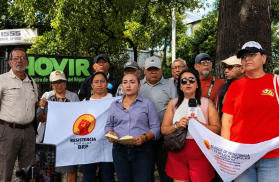
Despite the climate of increasing repression against social protest and human rights defenders in El Salvador, the Movement of Victims of the Regime (MOVIR) marched to the Legislative Assembly on June 25 to call on the legislature to not further extend pre-trial detention for tens of thousands of people unjustly arrested under the State of Exception. Accompanied by Social Justice and Citizen Comptrollers, dozens of families whose loved ones have been arbitrarily detained, in many cases since 2022, presented a formal request to the legislature not to extend Decree 803, a measure approved in July 2023 that de facto extended provisional detention for up to two additional years so the Attorney General could prepare for mass trials. The families denounced that the decree, which is set to expire in August, makes it easier for the state to prosecute innocent people alongside alleged members of criminal structures, as they will not have access to an individualized defense.
Prior to the approval of Decree 803, the Attorney General's Office had to request and justify to a judge the extension of pre-trial detention periods every six months on a case-by-case basis. The decree eliminated this periodic judicial review for those who had been detained under the State of Exception, an “emergency measure” instituted in March 2022 that suspends basic constitutional rights and due process. Under the State of Exception, security forces have arrested over 86,000 people without warrants; El Salvador now has the world’s highest per capita prison population.
Tens of thousands of people with no prior criminal record or evidence presented against them had already been imprisoned for over a year when the Legislative Assembly, dominated by Bukele’s New Ideas party, approved Decree 803. By summarily granting the Attorney General up to two more years for its “investigative” phase before holding a preliminary hearing, the result is that most people detained under the State of Exception have now been detained for over three years, even if no evidence has been presented against them. In an interview with YSUCA in October of last year, Ingrid Escobar of Socorro Jurídico denounced that as a consequence of the decree, hundreds have died in custody awaiting a preliminary hearing.
The decree is a legal tool that also permits and facilitates the Attorney General's Office (FGR) to group detainees in “blocs” according to their alleged membership in criminal structures and to prosecute them collectively under a single case. This will result in mass hearings and trials (there have been initial hearings involving almost 500 people), without evaluation of evidence or facts on an individualized basis. The preliminary hearings themselves, when they are finally scheduled, are likely to also take place in a mass, generalized manner.
The logic of this procedure, according to MOVIR, is based on the presumption of guilt by association and completely undermines the guarantee of due process.
For MOVIR spokesperson, Samuel Ramirez, “The most dangerous thing about Decree 803 is that it institutionalizes the idea that it is acceptable to keep a person in prison even if there is no evidence against them,” he warns. In his opinion, the state is consolidating a model of justice based on collective punishment, in which anyone arrested under the State of Exception is treated as guilty and subjected to prolonged detention without trial.
This decree adds to a series of legal reforms approved over the last three years that have contributed to the weakening of the system of procedural guarantees in El Salvador, legitimizing the coercive and repressive model established under the State of Exception. In March 2022, with the approval of Legislative Decree 339, legislators eliminated access to alternatives to prison for people accused of gang-related crimes, even if they have not been convicted in court, and removed the time limit on pretrial detention altogether for people accused of “serious crimes,” including “illicit associations” and any crime committed by someone accused of being in a gang. This, therefore, applies to most of the people arbitrarily arrested under the State of Exception. The same decree also enabled the use of anonymous judges, raising concerns about judicial transparency and the right to an adequate defense.
Recently, in February 2025, another amendment to Article 8 of the Criminal Procedure Code was approved, establishing that, for all other crimes, pretrial detention may be extended to half the maximum sentence for the alleged crime. This means that a person accused of a crime with a 30-year sentence could spend up to 15 years in prison before ever having a trial, let alone a conviction.
According to the government, these measures are intended to prevent the accused from evading justice. But MOVIR warns that, in practice, preventive detention has ceased to be an exceptional measure, as the law previously defined it, and has instead become the crux of the criminal justice system itself. By promoting a punitive model and the violation of basic rights as an acceptable strategy for combatting violence and restoring public security, the Bukele regime reinforces the idea that anyone detained is automatically guilty.
These narratives, disseminated by official media and associated social media platforms, criminalizing wide swaths of the population also paint those who question the arbitrary detentions as “enemies of peace” or “defenders of criminals”. Such a discourse also invisibilizes the anguish of thousands of families who have not received information on the whereabouts or situation of their detained relatives, as well as the denunciations of inhumane detention conditions, medical negligence, torture and at least 400 deaths in state custody, according to data from Socorro Jurídico Humanitario.
Despite complaints presented to both government institutions and international organizations, the government has not established any transparency mechanisms, nor has there been any accountability for any illegal detentions, state disappearances, or conditions in prisons, despite recommendations from the Inter-American Human Rights Commission, including to re-establish rights and due process guarantees that have been suspended.
On the contrary, the Bukele regime has launched a dangerous new push to justify the continuation of the State of Exception. On June 21, four days before MOVIR’s march to the legislature, the government deployed over 2,000 soldiers and police to the community of San Bartolo, Ilopango, arguing that criminal structures were trying to reorganize in the area. President Bukele announced the operation on social media, without offering evidence to support the government’s claim. For MOVIR’s Ramirez, these deployments are part of a strategy that combines repression with propaganda in order to normalize the violation of the population’s fundamental rights.
As the August 23 deadline approaches for the additional two years that Decree 803 granted to state prosecutors to prepare their mass trials, families of victims of the regime are concerned that the prosecution will request additional time, either through an extension of the decree or through other mechanisms. Instead, they demand the immediate release of victims of arbitrary arrest for whom the Attorney General has failed to provide evidence of wrongdoing. In their petition requesting that Decree 803 not be extended, MOVIR also called for a review of its application, for the individualization of cases, and for guaranteed access to effective legal defense and dignified conditions in prison.
If these demands are not met, say MOVIR and Social Justice and Citizen Comptrollers, there is a risk of permanently weakening the rule of law. “We are moving away from a system of justice,” Ramirez warns. “If the regime is bothered by our struggle, let the arbitrary arrests be stopped and the innocent be released. MOVIR will continue to exist as long as human rights violations continue."

 "I am a CISPES supporter because continuing to fight for social justice and a more people-centered country means continuing the dream and sacrifice of thousands of my fellow Salvadorans who died for that vision.” - Padre Carlos, New York City