Nayib Bukele Loyalists Reform Constitution to Allow Indefinite Reelection
On the night of July 31, Nayib Buckle’s Nuevas Ideas party rushed the approval of a series of alarming reforms to the Salvadoran Constitution regarding presidential elections. The constitutional amendments allow for indefinite reelection, extend the presidential term from five to six years, eliminate run-off elections, and move up the 2029 presidential elections to 2027, to coincide with the legislative and municipal elections. The reforms were approved and ratified in a single day's session, without debate and without public consultation.
Prior to these reforms, El Salvador’s constitution upheld the principle of alternation of power by prohibiting immediate presidential reelection, something that has been part of several versions of the constitution since 1841. The constitution of 1886 went further, converting the articles referring to presidential reelection into unalterable clauses, meaning that they cannot be reformed without a Constituent Assembly, establishing them as central to the country’s form of government (read here for background on how Nuevas Ideas legislators granted themselves powers of a Constituent Assembly in April 2024). Bukele's candidacy for a second consecutive term, in violation of this principle, came after a Supreme Court ruling by magistrates who had been illegally imposed by a Nuevas Ideas-controlled Legislative Assembly and that ignored the constitution's prohibitions on consecutive reelection. These recent reforms eliminated the constitutional barriers designed to prevent a single person from remaining in power indefinitely.
The run-off election was introduced with the 1983 Constitution, at the beginning of the country's democratization process, after decades of military dictatorship. It required that, in order to win a presidential election, an absolute majority (50% +1) be obtained; otherwise, the two candidates with the most votes would go to a final round, and the one with the highest number of votes would be elected. Now, the required votes to be elected will be less demanding, which benefits Bukele, who is already in his second consecutive presidential term, with control of the other branches of government in a context where the systematic persecution and imprisonment of critical voices has become State policy.
These reforms are just the latest attack against the system of a pluralist democracy that El Salvador established coming out of the civil war, which popular social movement groups have been taking to the streets to defend for the past several years.
Reactions from El Salvador's popular social movement
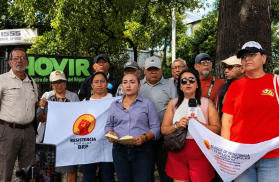
The Popular Resistance and Rebellion Bloc (BRP) denounced in a public statement that these are "modifications to the political or electoral system [that] are illegitimate and illegal," imposed by "a de facto power, arising from a continuous reelection that is unconstitutional." According to the BRP, this new onslaught by the regime seeks to deepen the concentration of power in the executive branch and adds to the illegal changes made before the 2024 elections, such as the elimination of municipalities and provincial councils and the alteration of the electoral quotient.
According to the statement, “the ruling clan knows that the hopes for improvements they have sold to the people are unrealistic,” and the reality in the country is “unemployment, rising prices, erosion of income, deterioration of health, education, and water services,” with increases in “hunger, poverty, and emigration”—things they assure will continue to worsen under the agreement with the IMF, which requires cuts to public finances, “more layoffs, new taxes, and [will result in] more poverty.”
They denounce that "the ruling clan knows that large swaths of the population will be disappointed" and that "that is why it increases repression and concentrates power," warning that "excessive power does not guarantee the country's political stability but rather degrades the living conditions of the people and concentrates wealth in the hands of a very wealthy minority."
U.S. government approval
On August 6, several media outlets reported on comments by a spokesperson from the U.S. Department of State defending the reforms, stating that “the decision to make constitutional changes is theirs [the Salvadoran people’s].” Such a position of neutrality and respect for self-determination is, of course, one that nations across Latin America and around the world have long demanded from the U.S. but it seems only to apply to right-wing political movements and governments. The spokesperson was quick to justify the contradiction, describing the Salvadoran Legislative Assembly as “democratically elected” and rejecting comparisons of the reforms in El Salvador with those of “illegitimate dictatorial regimes in other parts of our region.”
The U.S. government has long played a key role in legitimizing Bukele's concentration of power. While collaboration between the U.S. and Bukele's government has intensified under Trump, the position of approval, despite blatant constitutional violations and illegalities while Bukele's regime consolidated power, was also true under the Biden administration. These Trump State Department comments are not very different from those of Brian Nichols, former deputy secretary under Biden, who said before the January 2024 presidential elections that the Salvadoran people would resolve the issue of Bukele’s unconstitutional election “at the polls." Nichols comments conveniently ignored the military siege and suspension of constitutional rights that curtailed the possibility of a fair and free elections that year and made it seem as though a presidential election itself could replace the role of a constituent assembly, which is what the Salvadoran constitution required.
In March 2024, following elections marked by serious accusations of irregularities, the Biden State Department issued statements recognizing the results without objections and omitting allegations of public resource misappropriation, institutional collapse, and judicial system cooptation. A large high-level Biden State Department delegation attended the inauguration of Bukele's unconstitutional second consecutive term for which Secretary Blinken also issued congratulatory remarks and a commitment to "continued partnership and collaboration."
The public posture of neutrality and "partnership" under Biden helped normalize Bukele’s authoritarianism and is a significant precursor for these statements by the Trump State Department, reflecting the bipartisan consensus in Washington: denounce governments as illegitimate and dictatorial only when they challenge the geopolitical and economic interests of the U.S. and its business elites.
Reforms consolidate a process toward dictatorship that began years ago
While comments coming from the State Department attempt to legitimize the Legislative Assembly and its actions, these reforms are the culmination of illegalities and maneuvers intended to undermine El Salvador’s pluralist democracy.
Back in April 2024, one month before the end of the previous 2021-2024 legislative period, the Nuevas Ideas controlled Legislative Assembly approved an amendment to Article 248 of the Constitution, which establishes the process for constitutional reform*. This amendment eliminated the requirement of two consecutive legislatures needed for the approval and ratification of any reform to the Constitution. Previously, if a legislature approved a constitutional reform by a simple majority, it would have to be ratified by two-thirds of the next legislature, i.e., by a new group of elected legislators. Under this reform, all future reforms to the Constitution can be ratified within the same legislature with a 4/5 vote. Subsequently, in January 2025, the current Legislative Assembly—once again controlled by Nuevas Ideas and its allies—ratified the amendment, thus granting itself the power to rewrite the constitution in a single legislative term. Numerous legal and social movement groups and analysts described the maneuver as a constitutional coup in the 21st century.
Contrary to the comments coming from the State Department, the Nuevas Ideas Legislators that promoted and approved last week’s reforms came to power through a highly questioned electoral process leading up to and through the legislative, municipal and presidential elections of 2024.
In 2023, the Bukele government, through the Nuevas Ideas party, reduced the number of legislative seats, modified the seat allocation system, eliminated more than 200 municipalities, and manipulated the rules of the electoral process. These reforms were also approved in an expedited manner and without public consultation, just months before the 2024 elections.
These changes to the electoral system favored Nuevas Ideas, as it reduced proportional representation and limited the opportunities for minority parties to win seats, further concentrating power in the hands of the majority party. By reducing the size of the Assembly from 84 to 60 deputies and eliminating the residual system—which allowed parties with fewer votes to also access representation—only parties with high votes could obtain legislative representation, excluding the others and strengthening the control of Nuevas Ideas, which still held large majority support. Experts who have analyzed the results of the 2024 elections have explained that without the reforms, the representation of the leftist FMLN party, for example, would have increased from 4 to 6 seats; in the current assembly, there are 0.
These elections, in addition to the changes to the electoral system intended to benefit the ruling party, took place amidst a context of repression under the State of Emergency and were marked by serious allegations of electoral fraud throughout the vote count.
In their response to the reforms, the BRP also put the support of these legislators into question saying “the people reject [Nuevas Ideas] mayors and representatives, which is why they now intend to align the presidential election with the legislative and municipal elections,” and made an urgent call to “strengthen the organization in communities, neighborhoods, barrios, and territories to fight for the defense of their rights and build a society with social justice, freedom, and dignity.”
--
*The timing itself of the April 2024 amendment's introduction and approval by the previous legislature constituted a violation of Article 248 of the Constitution, as it establishes that no constitutional reforms can be introduced or approved during the “lame duck” period between governments, requiring a legislative election to take place between approval and ratification so that citizens can express their support or rejection at the polls of the legislators and their proposed constitutional reforms. However, the first approval occurred in April, months after the legislative elections of February 4, 2024, which violated this requirement and denied citizens the possibility of weighing in on the reform.

 "I am a CISPES supporter because continuing to fight for social justice and a more people-centered country means continuing the dream and sacrifice of thousands of my fellow Salvadorans who died for that vision.” - Padre Carlos, New York City