36 years after the deadly attack on FENASTRAS, salvadoran unions denounce setbacks in labor rights
On October 31, 2025, the Salvadoran labor movement commemorated Salvadoran Trade Unionist Day, a date that honors the memory of the nine workers murdered in the 1989 bombing of the National Federation of Salvadoran Workers' Unions (FENASTRAS), among them the historic union leader Febe Elizabeth Velásquez.
At the time of her assassination, Febe Elizabeth was serving as general secretary of FENASTRAS. The attack became one of the most brutal acts of aggression against the Salvadoran labor movement and remains a symbol of resistance and remembrance.
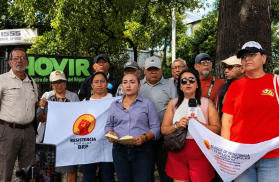
Thirty-six years after the attack, labor unions mobilized again, this time to denounce the repression and persecution of unions under the Nayib Bukele regime, which has criminalized collective organizing and dismissed hundreds of public sector workers for their union membership.
The labor sector of the Popular Resistance and Rebellion Bloc (BRP) and the Permanent Roundtable for Labor Justice held a rally in Cuscatlán Park, denouncing the harassment of unions, the dismantling of the public sector, and the criminalization of labor leaders. In their statement, representatives of the Popular Resistance Bloc declared that “the labor movement is being persecuted and subjected to violence.”
In a statement, the BRP denounced that “El Salvador is experiencing a clear setback in the protection and respect of labor and union rights” and that “there is a strategy of eliminating union leadership, with the closure of public and municipal institutions and through the rigged guise of 'supresion de plazas' (translation: position elimination)."
For its part, the National Confederation of Salvadoran Workers (CNTS) held a commemorative event and rally where a statement was read, demanding that the government led by Nayib Bukele respect the sacred freedom of association and the right to organize, which have been won at the cost of the blood of working-class martyrs. They also denounced the setbacks in the rights of working women in all sectors.
In 2024, the CNTS denounced a systematic campaign of labor repression before the ILO, the IACHR, and international forums, as well as violations of both the Constitution and ILO Conventions 87 and 98. These denunciations included at least 30 cases of violations of freedom of association, mass layoffs, arbitrary imprisonments, and forced exiles.
According to union reports and independent media, between 2019 and 2025, between 40,000 and 50,000 public sector layoffs were recorded, including more than 500 union leaders. In 2025 alone, through September, 17,800 public sector workers had been dismissed primarily in healthcare, education, municipal, and culture workers—many with union immunity.
In addition, the Movement of Victims of the Regime (MOVIR) and BRP have documented dozens of arbitrary arrests and even deaths of union leaders in state custody. Among the emblematic cases is that of Silverio Morales, an Indigenous and union leader from MUINA/MILPA, whose family has been victims of arbitrary detentions, including the recapture of his son Levi Morales in 2024 despite evidence of his innocence; and union leader José Leonidas Bonilla Torres, from the Mejicanos Mayor's Office, who died in the Mariona prison in 2022 after being arrested on false charges. And the leader Hever Chacón, who died in 2024 from lack of medical attention while detained for participating in a protest. Others, such as Giovanni Aguirre, a union leader from the San Salvador City Hall, and Óscar René Iglesias, a leader from the eastern part of the country, remain imprisoned without evidence on fabricated charges.
They also warn that more than 60 unions have been dissolved or dismantled, destroying collective bargaining agreements and violating the constitutional right to organize. In many cases, the dismissals are justified under the official discourse of “state restructuring” or “resource optimization,” while the criminalization of protests and the censorship of labor dissent intensify.
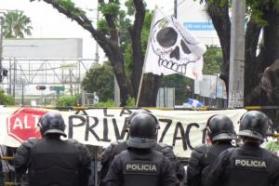
The organizations pointed out that while the government promotes mega-privatization projects such as the National Hospital Network and the handover of public services to private hands, job insecurity, wage inequality, and political control over the institutions responsible for protecting workers' rights are deepening. “Labor institutions,” they warned, “no longer protect, but rather obey,” reflecting the climate of authoritarianism and institutional dismantling that characterizes this government.
In that context, the trade union movement called for unity, mobilization, and to "raise our voices together for trade union freedom, labor justice, and the rights of the working people," claiming this commemoration not as a symbolic act, but as a day of resistance and hope.
 "I am a CISPES supporter because continuing to fight for social justice and a more people-centered country means continuing the dream and sacrifice of thousands of my fellow Salvadorans who died for that vision.” - Padre Carlos, New York City