Social Movement Mobilizes During Holy Week
During Holy Week in San Salvador, social movement groups in San Salvador held several protests denouncing mass firings of healthcare workers, political imprisonment, and unjust arbitrary arrests, contrasting the suffering these cause with the significance of the date, whether religious or in terms of labor rights. While the holiday is a time of religious reflection and rest, with public sector workers enjoying a paid week of vacation, hundreds have been unjustly fired and tens of thousands suffer the impacts of four years of a State of Exception, implemented in March 2022, in the name of public security.
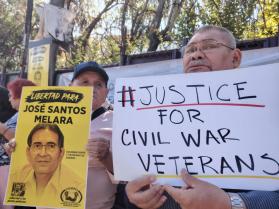
Members of the Movimiento de Víctimas del Régimen (MOVIR) marched to the Historic Center, carrying signs and testimonies showing the human cost of Bukele’s policies. MOVIR representatives pointed to patterns of arbitrary detentions, cases lacking sufficient evidence, and judicial processes that fail to guarantee the right to defense., —issues they say are often absent from official narratives. They also highlighted the human toll of prolonged pretrial detention, where individuals remain incarcerated for years only to face mass trials that risk turning justice into a collective sentence rather than an individualized process.
While acknowledging that violence and gang control have long been urgent concerns for Salvadorans, participants emphasized that the fight against crime cannot come at the cost of fundamental rights, due process, and human dignity.
Beyond the legal concerns, participants described a broader climate of fear, as entire communities are experiencing stigmatization and persecution, while families are left in anguish, often without information about the whereabouts or well-being of their detained relatives. Reports of incarcerated individuals subjected to forced labor without compensation further deepen concerns about the conditions inside the country’s prisons.
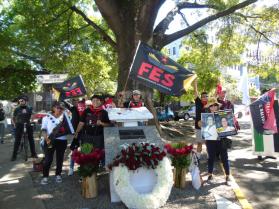
These testimonies were echoed by members of the Committee of Families of Political Prisoners and the Politically Persecuted (COFAPPES), which, alongside other grassroots organizations and affected communities, organized a symbolic Stations of the Cross or “viacrucis” to represent the suffering endured by those detained and their families.
“We are here in solidarity with Ruth López and with all those who are political prisoners,” said Lourdes Palacios of COFAPPES, underscoring the broader concern that the Sstate of Eexception is being used not only against alleged gang members but also against individuals perceived as political opponents for denouncing human rights abuses, corruption or other abuses of power.
Communities from the Bajo Lempa, who have organized similar actions for the past two years, described the situation as “the same story repeating itself,” a system that continues to punish the innocent. Their participation included artistic representations of the Stations of the Cross, linking each stage to documented human rights violations under the current security policies, serving as both memorial and protest.
Four years after its implementation, the State of Exception continues to shape daily life in El Salvador. Introduced on March 27, 2022, the measure suspended basic constitutional rights under the justification of combating gang violence. In practice, it has led to tens of thousands of arbitrary arrests and widespread human rights abuses, while also functioning as a tool for political repression and the consolidation of power. In March, an international group of jurists released a powerful report concluding that “serious human rights violations committed by the government of El Salvador during the state of emergency may indeed constitute crimes against humanity because of the widespread and systematic nature of the attacks, their commission against the civilian population, and their commission as part of a State policy or plan.”
In parallel, health sector workers gathered under the Popular Resistance and Rebellion Bloc (BRP) held a public press conference to denounce labor rights violations. “We are facing arbitrary dismissals, unpaid salaries, violations of due process, and the denial of fair compensation,” they stated. Participants emphasized that the mass dismissals carried out in December 2025 occurred “without formal notification, without the right to defense, and without compliance with procedures established by law.”
Workers also highlighted the human impact of these measures, noting that “there are families without sustenance, workers who have been silenced, and households facing uncertainty,” and stressing that “this is not only a labor issue, it is a human problem.” They called on the Ministry of Labor and the Ministry of Health to investigate the cases, guarantee due process, pay withheld salaries, and provide immediate and fair severance.
Participants across various actions during Holy Week also called for justice, the release of those unjustly detained, and an end to the state of exception, urging instead the adoption of security policies that guarantee human rights and due process.
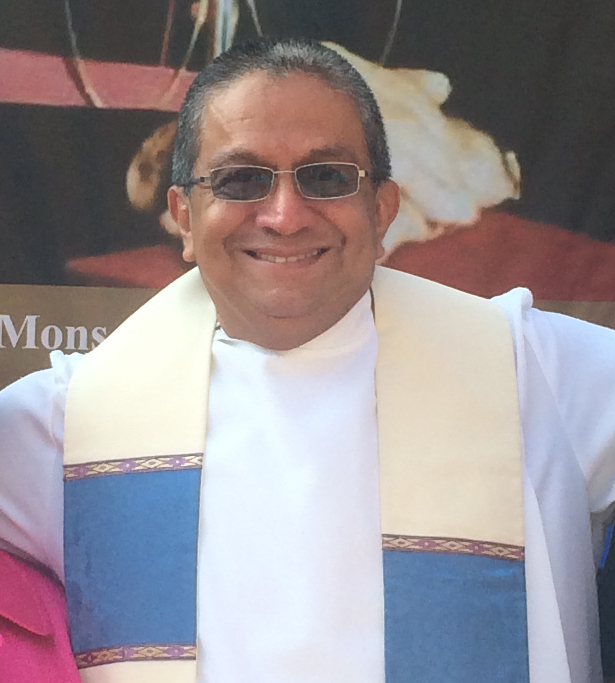 "I am a CISPES supporter because continuing to fight for social justice and a more people-centered country means continuing the dream and sacrifice of thousands of my fellow Salvadorans who died for that vision.” - Padre Carlos, New York City