Salvadoran legal experts challenge Trump-Bukele CECOT deal
On April 4, leaders with the Popular Resistance and Rebellion Bloc (BRP) presented an official complaint to the Supreme Court, arguing that recent transfers of Venezuelans from the United States to the maximum security Terrorism Confinement Center (CECOT) violate the El Salvador’s constitution, as well as international conventions to which it is a signatory.
In a statement accompanying the delivery of the complaint, the BRP demands the release of the Venezuelan citizens, citing seven different constitutional articles governing the signing of treaties as well as guaranteeing individuals’ fundamental rights.
Despite a judge’s order halting their transfer, on March 15, 238 Venezuelans were sent from the United States to be imprisoned in El Salvador for at least a year for a payment of $6 million. Two weeks later, an additional 17 Venezuelans were sent to CECOT.
The delivery follows a series of actions in El Salvador rejecting the agreement between Nayib Bukele and the Trump administration. Messages of support for the detained migrants were present in protests on March 26 and 27. Lawyers also submitted 30 writs of habeas corpus on March 25 on behalf of the imprisoned Venezuelans.
Legal experts and human rights organizations have also criticized the detention of Venezuelans in CECOT. In an interview, Salvadoran constitutional lawyer Enrique Anaya questioned the legal basis of the deal. "In El Salvador there is no law that authorizes us to hold prisoners who have not been convicted in El Salvador. So, on what legal basis are they going to hold people, regardless of their nationality, who have not committed a crime in El Salvador?”
Ruth Eleanora López, head of the human rights organization Cristosal's Anti-Corruption and Justice Unit, pointed out on X that the agreement violates multiple provisions of the Inter-American Convention on the Serving of Sentences Abroad, to which El Salvador is a signatory. The Convention requires that the individual “must consent to the transfer” and “must be a national of the receiving state.”
At an April 28th press conference, Noah Bullock of Cristosal presented their findings on an investigation into the Venezuelans sent from the U.S. to El Salvador. Their research revealed that 44% of the individuals sent to El Salvador had some sort of immigration protection such as TPS or asylum. None have had contact with their families.
At that same press conference, Kerry Kennedy from Robert F. Kennedy Human Rights, which represents 10 of the detainees, announced that they were denied access to their clients, as well as entry to CECOT and the Mariona prison. While in the country they also met with several other human rights and victims groups to learn about the conditions in the other prisons and under the state of exception.
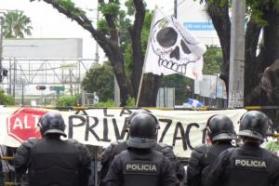
At one point, Cristosal executive director Noah Bullock interrupted the presentation to warn the media of the arrival of police officers in the building. Cristosal later released a statement saying that the police were investigating “a supposed demonstration in support of Venezuelans” and taking pictures of the building and license plates in the parking lot. The statement also denounced “authoritarianism and the closing of democratic spaces in El Salvador.”
The Trump administration, as well as prominent MAGA leaders, have long praised Bukele’s tactics, including a State of Exception that has now been in place for over three years and suspends civil liberties for all Salvadorans. It has lead to the incarceration of over 85,000 people without due process, leading El Salvador to have the highest incarceration rate in the world. Critics fear that the cozy relationship between the two governments could lead to an adoption of similar measures in the U.S. Elon Musk has said that the approach “needs to and will happen in America.”
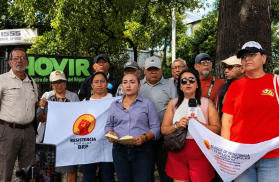
At a protest led by the Movement of Victims of the Regime (MOVIR) and accompanied by several social movement groups, BRP representative Marisela Ramirez expressed concern about the measures now being applied to Venezuelans who have not faced trial or been accused of a crime in El Salvador. “We are alarmed by the fact that this policy of discrimination and persecution that the government of El Salvador and the de facto president Nayib Bukele have been carrying out since the beginning of his presidency has now been broadened beyond El Salvador’s borders.”
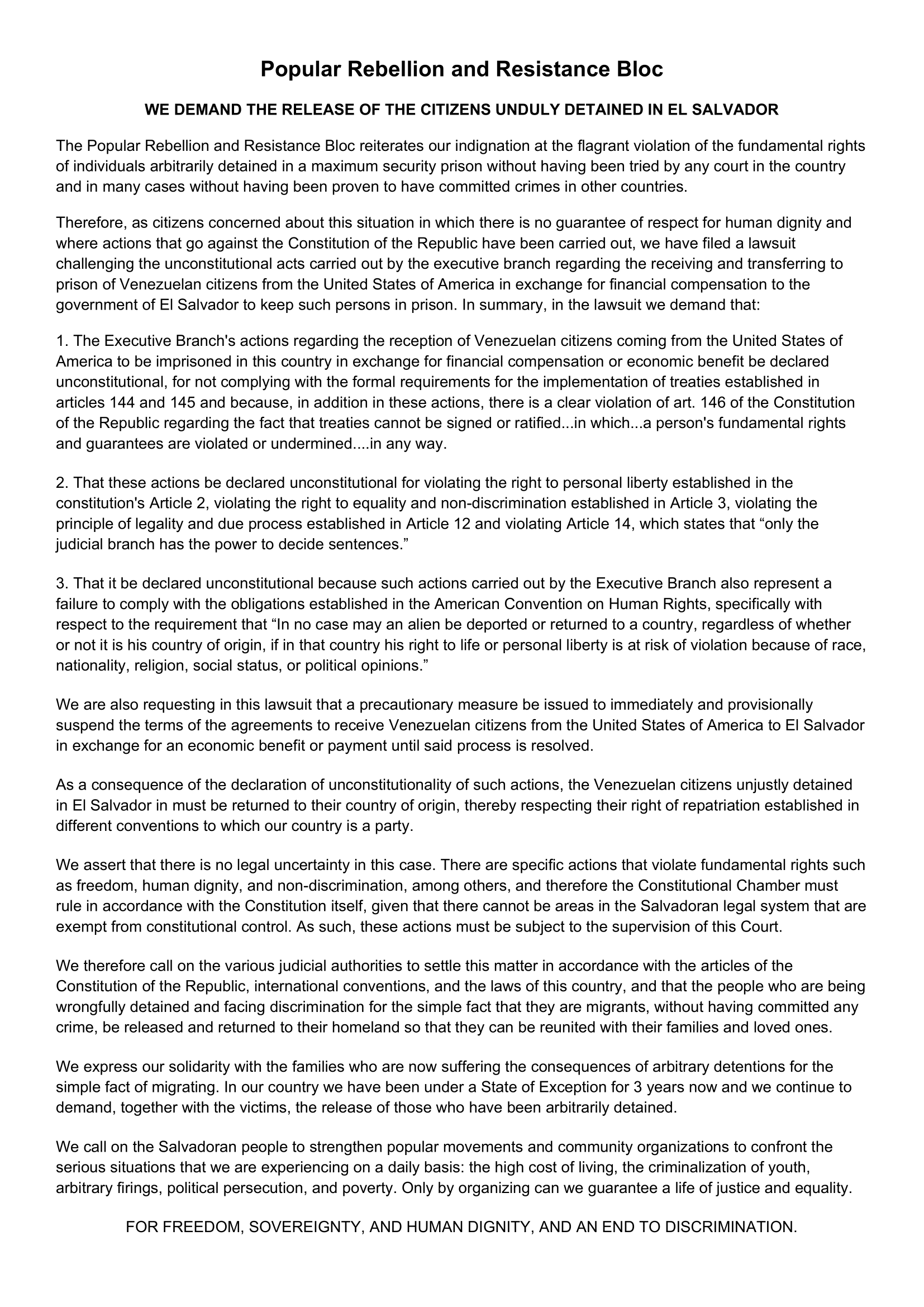
Our translaion of the Popular Resistance and Rebellion Bloc's statement is below.
 "I am a CISPES supporter because continuing to fight for social justice and a more people-centered country means continuing the dream and sacrifice of thousands of my fellow Salvadorans who died for that vision.” - Padre Carlos, New York City