May Day marches fill the streets of San Salvador
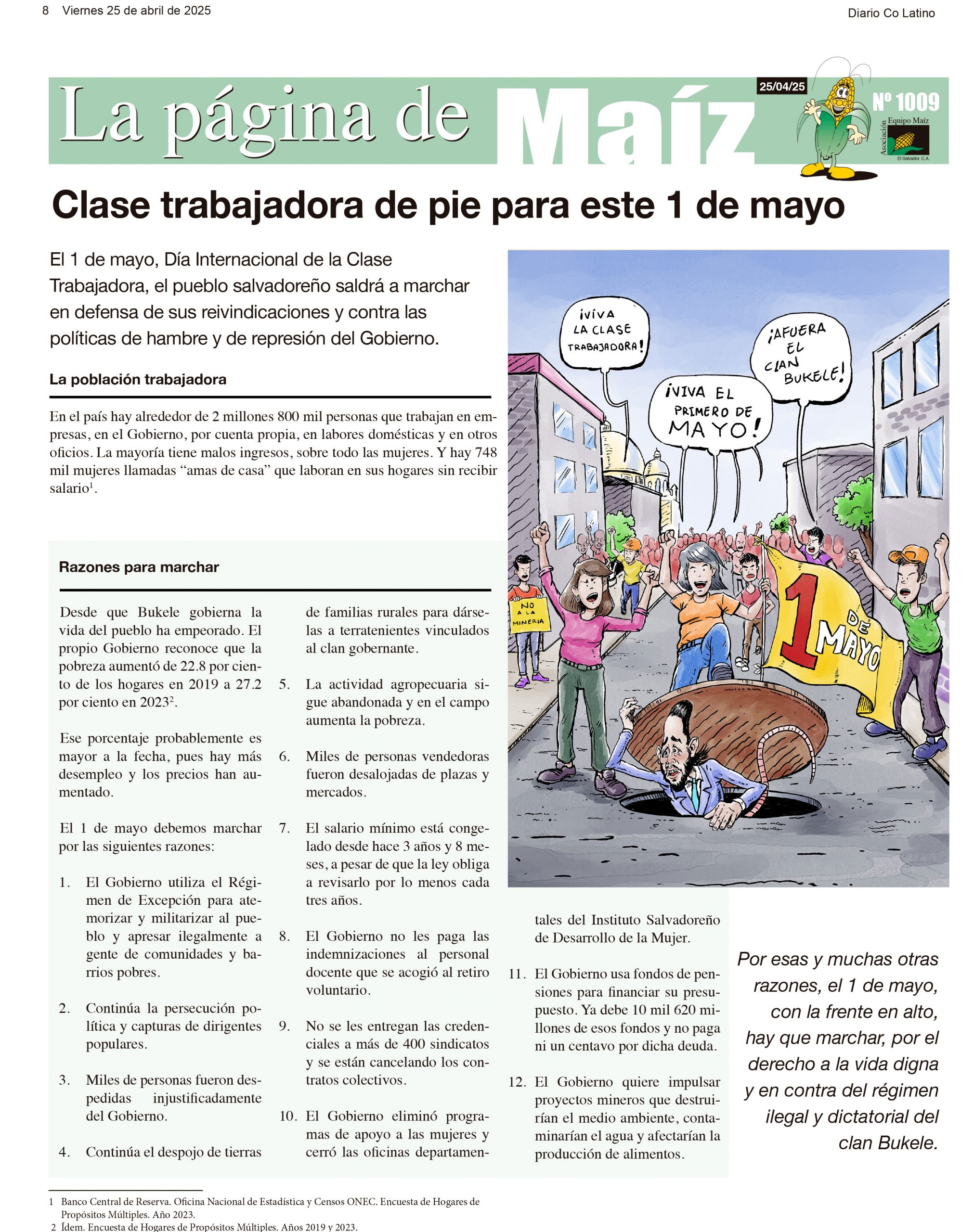
Thousands of Salvadorans took to the streets to celebrate International Workers’ Day, denouncing mass public sector layoffs, attacks on organized and informal labor, and political persecution against union and social movement leaders. Two marches, organized by the Popular Rebellion and Resistance Bloc (BRP) and the Movement in Defense of Working Class Rights (MDCT), wound through San Salvador before finishing at the Civic Plaza, in front of the National Palace and National Library.
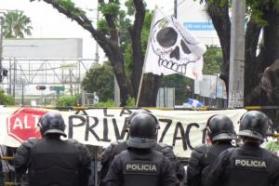
March organizers denounced as many as 40 police checkpoints Thursday morning on roads leading to the capital. One group traveling from Espiritu Santo Island saw their cell phones confiscated temporarily and another group denounced the destruction of video equipment. Another major highway connecting the western departments with the capital was closed by a landslide in a construction zone.
Over 35,000 public sector workers have been laid off by the Nayib Bukele government since taking power in 2019. The rate of these layoffs is drastically increasing, as 14,000 public sector workers lost their jobs in 2024 and an additional 8,000 have been fired this year alone. These layoffs, which include 4,000 teachers, are accompanied by a shrinking economy and additional cuts in government programs that have resulted in the closure of at least 67 schools and 3 community health centers, affecting 101,000 patients. The poverty rate under Bukele has also grown close to 5 points.
In a press conference before the BRP march, Sonia Urrutia announced, “The Popular Resistance and Rebellion Bloc is an alliance of 34 organizations and, together with 20 other organizations, we have organized this march to the National Library where we will be denouncing the different setbacks that we have suffered under this government. When Bukele came to power in 2019, the first thing he did was carry out mass firings of workers.”
Hundreds of family members of individuals who have been jailed with no due process under the State of Exception also joined the march. The measure initially instituted for one month, has been in effect for over three years and has resulted in the incarceration of over 85,000 people. According to the Movement of Victims of the Regime (MOVIR), thousands have been effectively disappeared, as they have had no contact with lawyers or family members for years. One mother lamented, “They have been in there for three years now and we don't know if they are dead or alive. People are dying in there, getting sick with stomach diseases, and sleeping on the pavement.”
According to MOVIR spokesperson Samuel Ramírez, “There are many workers, both public and private sector, who have been arrested under the State of Exception. We believe that it is right to raise our voices for these people who were unjustly incarcerated. That is why we, together with the working class, are here in commemoration of the Chicago martyrs who also died defending the rights of the working class.”
The State of Exception, as Marisela Ramírez of the BRP explains, has contributed to the mass migration of rural youth from the country, as they find themselves profiled by police and military. The problem is exacerbated by land grabs across the country for megaprojects and tourist infrastructure. In late February, human rights defender Fidel Zavala was arrested along with 20 leaders of the rural La Floresta community as they fought to legalize the community’s ownership of their homes. The community has since been demolished.
An April report by Salvadoran new outlet MalaYerba also revealed that Nayib Bukele has purchased a million dollar beachfront property that includes a natural protected area. During the last three years, Bukele and his family have bought $10.5 million worth of property.
MDCT march
A second march, convened by the Movement to Defend the Rights of the Working Class (MDCT), began at the Savior of the World monument. In addition to the 50 unions and six union federations that make up the MDCT, dozens of other groups attended the march.
The MDCT formed last October in response to a 2025 budget proposal that was approved by the Bukele-controlled Legislative Assembly, drastically cutting funds from the ministries of health, education, agriculture, and culture. Public workers and supporters took to the streets by the thousands to oppose the bill and hundreds of healthcare workers and teachers were fired for their participation in the events.
MDCT leader Erick Zelaya attributes the recent wave of mass firings of public workers to a $14 IMF loan approved earlier this year. “The IMF offered the government an urgently needed lifeline in exchange for cuts in public spending. They imposed a series of structural adjustments, which were incredibly harmful for the working class.”
One of those austerity measures, according to Ramírez, is a $60 million budget cut in the Ministry of Agriculture. Even with the reduced budget, the Ministry of Agriculture is spending only 60% of its allocated funds. “60,000 jobs have already been lost in this industry,” says Ramírez. “And we want to know what is happening with the money that isn’t being spent.”
Attacks on labor
Zelaya also denounced the war on unions in which the elected leadership of 455 unions have been fired and the government has refused to grant credentials to 400 unions, halting their ability to represent their members. “Industry contracts cannot be negotiated because entire executive boards have been removed,” Zelaya added.
18 unions have been eliminated through the closure of government institutions and 20 union leaders have been arrested under the State of Exception. Three remain in jail, including Giovanni Aguirre, who is being held despite a court-issued order for his release.
Workers in the informal sector, in which 70% of the country’s population labors, are also under attack. Over 30,000 informal workers have been displaced under Bukele’s government, mostly in areas that are undergoing renovations focused on improving tourism like the historic center of San Salvador and popular beach towns.
Increasing the minimum wage
Thursday’s marches took place a day after the National Minimum Wage Council met to approve a proposal by Nayib Bukele to raise the minimum wage by 12% on June 1. Despite being constitutionally required to revise the minimum wage every three years, El Salvador has not raised the minimum wage since 2021. Last year, the BRP proposed a minimum wage hike of 25% in response to the significant increase in the price of basic foods. The Roundtable on Food Sovereignty has proposed a 40% increase in the minimum wage.
El Salvador has different minimum wages according to sector, with the highest currently set at $365. A 12% increase would raise this to $402. Economists have decried the move as a smokescreen that would do little to help the working class in light of significant inflation. Instead, they claim, it is an attempt to appease a population that is increasingly unhappy with the government. Recent moves to reactivate metals mining and detain hundreds of Venezuelans and Salvadorans sent from the United States are also deeply unpopular. The Bukele government has also seen its media dominance threatened by recent scandals and failing infrastructure projects, affecting tens of thousands of Salvadorans.
According to Ramírez, Bukele “doesn’t want to improve workers’ precarious economic conditions or address the high cost of living. What he wants to do is have people talk about something else…We ask the president, if he really wants to help the working class, to propose a 25% increase in the minimum wage.”
 "I am a CISPES supporter because continuing to fight for social justice and a more people-centered country means continuing the dream and sacrifice of thousands of my fellow Salvadorans who died for that vision.” - Padre Carlos, New York City