Bukele: A Seven-Year Rule Beyond Constitutional Limits
As Nayib Bukele marks seven years in power, El Salvador’s popular social movement offered a starkly different assessment from the triumphalist narrative promoted by his government. In a joint review of Bukele’s seven years in office, representatives from healthcare labor unions, victims’ rights, and community groups denounced the domestic realities behind the internationally celebrated “Bukele model,” pointing to the concentration of power, the sweeping aside of constitutional limits on presidential re-election, normalization of emergency rule through a now permanent State of Exception, deteriorating public services, rising living costs, and imprisonment of social and community leaders without convictions.
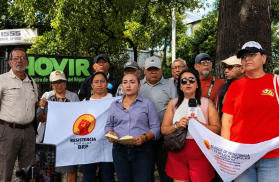
"At seven years of Nayib Bukele's governments, we denounce the serious democratic, economic, and social deterioration affecting El Salvador and the growing authoritarianism imposed by a family business clan allied with sectors of the oligarchy," stated the Popular Rebellion and Resistance Bloc (BRP).
The group also denounced that the Attorney General's Office, the Constitutional Chamber of the Supreme Court, and other state institutions have been used by Bukele "to guarantee the continuity of the ruling project and endorse the unconstitutional presidential reelection."
The press conference also called for the liberation of several social movement leaders of the Alliance for a Peaceful El Salvador, who were arrested two years ago after announcing peaceful protests against Bukele’s unconstitutional inauguration. "The unconstitutional government of Bukele was inaugurated through the violation of the fundamental rights of [the Alianza leaders]," said BRP representative Fran Omar during the event. According to Omar, their imprisonment "has not only restricted their freedom, but it has also led to the deterioration of health of these compañeros, who have even been at risk of losing their lives, as in the case of our compañero Atilio Montalvo."
The organizations' assessment also comes as the State of Exception enters its fifth year. Originally justified as part of the government's war on gangs, the measure has been used to persecute and imprison several leaders of El Salvador’s popular social movement.
Samuel Ramírez of the Movement of Victims of the State of Exception (MOVIR) noted that the Alianza's leaders were never accused of gang membership yet the State of Exception’s suspension of rights has been applied to their criminal prosecution. As of June 1, they had spent two years in prison without any crime being proven against them.
First approved in March 2022 the State of Exception remains in force more than four years later, suspending several constitutional protections, including due process guarantees, freedom of association, and access to legal counsel. National and international human rights groups like Socorro Juridico, Cristosal, and Human Rights Watch report that thousands of people who have been arrested under the measure had no ties to gangs.
During the press conference, MOVIR announced that it had filed another constitutional challenge against the State of Exception. "The regime is no longer being used to combat gangs. It is simply an instrument to terrorize the people, to arrest social movement leaders, as happened with the compañeros of Alianza El Salvador en Paz," Ramírez said.
Ramirez also explained that the MOVIR has previously filed three constitutional challenges and they have all been declared inadmissible by the Court. "Here there is no rule of law," he claimed. According to Socorro Jurídico Humanitario, more than 500 people have died in state custody since the measure was introduced, while at least 22 trade unionists have been detained under its provisions.
The repeated extensions of the emergency regime have drawn criticism from national and international human rights organizations, which have documented arbitrary detentions, deaths in custody, restrictions on due process, and obstacles to legal defense. A report presented before the IACHR concluded that there are reasonable grounds to believe crimes against humanity are being committed in El Salvador in connection with the implementation of the State of Exception.
Rafael Paz Narváez, of the Movimiento Universitario de Pensamiento Crítico, argued that the State of Exception has evolved into a mechanism that shapes public life far beyond security policy. "It has been a mechanism to ensure fear among a large number of citizens," he said, arguing that authorities have relied on mass arrests that include innocent people who have never received proper judicial review.
"A huge number of people have been captured under quotas and have not been afforded due process. Today they are subjected to mass trials that are completely improper under legal norms."
Narváez also pointed to what he described as growing pressure against journalists, environmental defenders, and community leaders, like the Santa Marta Five - water defense activists and community leaders who were arrested by the Bukele government after they denounced indications that his government planned to reverse the country’s historic ban on metal mining.
At least 86 people are currently considered political prisoners, while around 100 journalists have been forced into exile amid a climate of persecution and intimidation (according to the human rights group, Cristosal).
Narvaez also denounced “a campaign of dispossession against communities that obtained access to land through agrarian reform, through land transfer programs, or that have traditionally inhabited these territories.” In February of this year, despite avoiding the kinds of arrests experienced by the La Floresta and El Bosque communities in 2025, the San Francisco Angulo community was forced to concede in their organizing and protest against the construction of a mega landfill in their community after experiencing threats of mass arrests.
For the organizations, democratic backsliding has been accompanied by worsening economic and social conditions.
While the government concentrates power and propaganda, the population’s living conditions continue to deteriorate. Between 2019 and 2026, the cost of living rose by 30%, and more than 138,000 people fell into extreme poverty. The population faces unemployment, low wages, and constantly rising prices for food, energy, housing, and basic services.
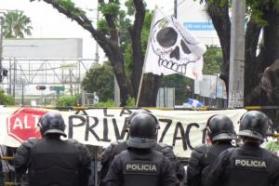
Public education is in decline: the number of schools has been reduced, student enrollment has fallen, more than a thousand teachers have been laid off, and the literacy program has been eliminated. In public health, the closure of health facilities, drug shortages, the layoff of specialized personnel, and the push toward privatization directly affect the working class.
Numerous social programs targeting youth, women, farmers, veterans, and other vulnerable sectors have also been eliminated. Agriculture and industry are experiencing declines in production, while corn and bean harvests are at some of the lowest levels in recent decades.
The BRP also noted that public debt has increased by roughly $14.5 billion during Bukele's presidency without this translating into a benefit for the people and denounced that public resources continue to flow to economic elites through contracts, tax incentives, and other arrangements.
Likewise, health workers denounced the deterioration of public healthcare and the undermining of workers' rights. Erika de León of the National Commission for the Defense of Public Health (CONADESA) said more than 7,000 health workers have been dismissed since 2025 and argued that the attacks extend beyond labor issues to constitutional protections themselves. "Here we have a misgovernment—or rather, a dictatorship. There are no constitutional guarantees. Human rights are being suppressed for the working class," she said.
Dr. Rafael Aguirre, Secretary General of the Union of Physician Workers of the Salvadoran Social Security Institute (SIMETRISSS) and member of CONADESA, described "a complete abandonment of health surveillance and epidemiological monitoring," linking the disappearance of community health teams to the reemergence of diseases. "We once again have malaria with us. We once again have screwworm infestations. At this moment we have a measles epidemic and increasing cases of rubella, mumps, among others," he said.
In their review, the organizations argue clearly that while living costs rise, public services weaken, and democratic guarantees erode, the main beneficiaries of Bukele's years in office have been politically connected economic sectors. Their assessment that differs sharply from the image promoted internationally by Bukele's government, which presents the country as a model of security, modernization, and efficient governance.
For the U.S. government’s part, starting with the Biden administration, public pressure was rolled back significantly as the Bukele government secured a second term despite constitutional prohibitions. Support for the Bukele government was cemented further in 2025 under the Trump administration - in August of 2025, the State Department released a significantly shortened Human Rights Report on El Salvador that largely bypassed the concerns repeatedly raised by civil society groups, independent journalists, and international human rights advocates
The easing of external scrutiny from the US State Department coincided with another major shift in El Salvador's political system. Constitutional reforms approved by Bukele's allies allow indefinite presidential reelection and extend presidential terms from five to six years. The Bukele controlled Supreme Electoral Tribunal subsequently moved the presidential election up by two years, shortening Bukele's current term and clearing the way for a new candidacy that could keep him in office at least until 2033.
For organizations already warning about the the political persecution, perpetuation of emergency rule, imprisonment of social leaders, dismantling of public services, the increasing concentration of power, and attacks on constitutional rights, the reforms mark not the culmination of a seven-year process, but the possibility of extending it well into the next decade.
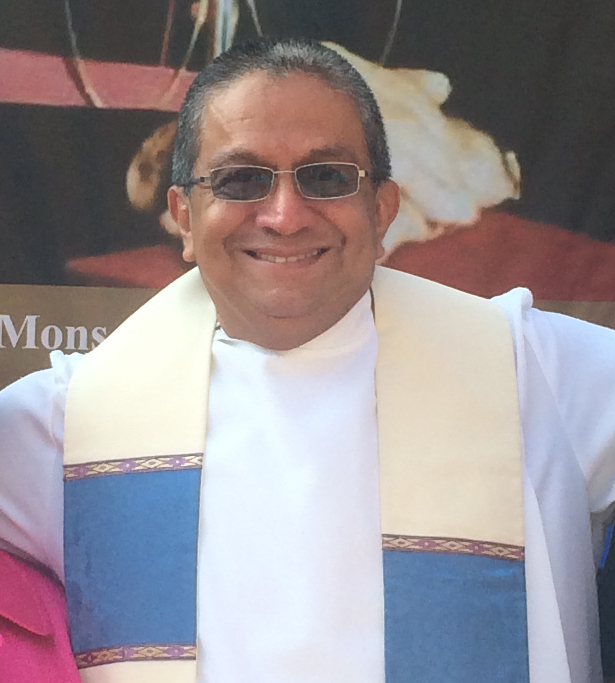 "I am a CISPES supporter because continuing to fight for social justice and a more people-centered country means continuing the dream and sacrifice of thousands of my fellow Salvadorans who died for that vision.” - Padre Carlos, New York City