Upside Down World: Building a New Society Through Education
Published in Upside Down World Written by Madeleine Conway, member of the University of Santa Cruz CISPES Chapter A participant in El Salvador’s National Literacy Program (NLP) stands before a crowd and reads, “My name is Rosa Elena Hidalgo...I would like to thank the Ministry of Education, the El Paisnal mayor’s office, and the teachers. Thanks to their effort, we, the adults, are learning to read and write since as children for various reasons we didn’t. Today our dreams are coming true.” Across the country, tens of thousands of people like Rosa are learning how to read and write. Under Salvador Sánchez Cerén, former Minister of Education, current Vice President, and historic leader of the FMLN (Farabundo Martí Front for National Liberation), the Ministry of Education (MinEd) has changed dramatically. For the first time in El Salvador’s history, the government is providing children with uniforms, school materials, and a daily meal, while at the same time combating illiteracy among adults. Since 2010, the MinEd has eradicated illiteracy in six municipalities and hopes to declare El Salvador’s illiteracy rate to be 4 percent or less by 2014. This summer, CISPES accompanied the NLP for three weeks – visiting dozens of community literacy circles, promoting the program on local and national media, and helping conduct a literacy census – as the first international volunteer brigade to answer the government’s call and support the literacy program. Twenty-eight university students, teachers, workers, mothers, and retirees participated in this historic literacy brigade, bringing hundreds of donated notebooks, pencils and eyeglasses in tow as material support. The first level of the NLP program uses a Cuban methodology to teach Salvadorans over the age of 14 how to read and write. They offer two more levels - up to a sixth grade education – after which participants have the option of receiving a high school degree through other MinEd adult education programs. In the first level, many participants start out with shaking hands as they hold a pencil for the first time. However, by their graduation after 5 months, they can read, write and solve mathematical problems at a 2nd-grade level. The second and third levels of the NLP continue to build comprehension, composition and math skills to ensure that participants not only know how to sign their names, but also understand the documents they sign. When the program began in 2010, about 680,000 Salvadorans, or 18% of the population could not read or write. In two years, over 130,000 adults have become literate. The first step in the program is to identify the possible literacy students with a door-to-door census conducted by NLP staff and community volunteers. In El Paisnal, high school students and community leaders worked side-by-side with CISPES and the NLP to identify the community members who were illiterate, who would like to join a free literacy class (that could even take place in their home), and who would like to continue their education up to a sixth-grade level. The program’s paid promoters work tirelessly to build local literacy circles in communities by convincing people who cannot read or write – many of whom are women in their 60s, 70s and 80s - to participate in this free literacy program, while simultaneously organizing community members and young students to share their knowledge and time as literacy teachers. Promoters often have to walk for hours to visit communities beyond the reach of public transportation or roads, sometimes enduring harsh weather conditions, to follow the progress of the literacy circles that they helped build. Additionally, they organize promotional events for the program along with the NLP directors. In Cojutepeque, Cuscatlán, municipal and departmental NLP staff and volunteers organized a 3K race in which elementary through high school students and CISPES delegates participated. Local news and radio stations broadcasted the race and invited people to join the literacy program to learn and to teach. The volunteer literacy teachers, called “facilitators”, are largely middle school and high school students. When we met with them at their schools they carried themselves with the endearing awkwardness of adolescents, but once they were facilitating literacy circles, they became more poised and sefl-assured. They sat with their family members and neighbors for hours every day for months, slowly going over letters and words. They demonstrated incredible patience and maturity. It was inspiring to watch these kids, some as young as nine-years-old, devoting themselves to their communities.  The workbooks used in the NLP also promote awareness of social issues such as violence against women, trash burning, and labor rights. In the second and third levels, participants are asked to comment on how the issues raised in the passages they read are connected to their own lives. In one literacy circle, a group of women and men discussed how it was unfair that women had to do all the chores at home while the men relaxed. In another group, participants discussed a love poem, while in others men sat in sweltering classrooms proudly writing their names. The range of teaching styles and literacy circle sizes varied widely. In Cuscatlán, the program’s director used a flexible time module to accommodate the busy lives of the participants in his area. We visited one of his literacy circles, where Doña Collinda diligently struggled to learn new letters. She told us that she doesn’t have time to sit and work for two hours every day because she has to leave to sell fish. Even in the time she does have, her daughter-in-law and facilitator had to run a kiosk and attend to her children during class. Doña Collinda never learned to read and write because she was orphaned as a child and stayed at home to help her aunt. She says that now her aunt feels badly for not sending her to school, but Doña Collinda is not resentful. She is among many whose parents or guardians were unable to send their children to school due to poverty. One of the meanings of the literacy program’s motto, “Querer es poder,” is “love is power”. The other meaning translates roughly into “wanting enables achieving”. Both of these translations aptly describe the way in which the NLP functions. Before the left came into power in 2009, MinEd adult literacy programs never managed to declare even a single municipality free of illiteracy; while the re-vamped NLP under FMLN leadership has managed to have 6 municipalities declared free of illiteracy in just two years. Despite these successes, right-wing parties and business associations claim the NLP is a gross misuse of public funds. Meanwhile, people from all parties are receiving benefits of the program and, in turn, becoming promoters in their own right. In Santa Cruz Analquito, Cuscatlán a woman with a right-wing GANA (Great Alliance for National Unity) party poster in her yard expressed her appreciation to the FMLN for the program. The literacy program exemplifies the spirit of FMLN governance, which seeks to create opportunities for tangible changes for the most marginalized communities, by empowering people to be protagonists for change in their lives. “Education is the foundation for development!” was the repeated PNA mantra, and the literacy staff apply this idea to the individual, the community, and society. Literacy is essential for a person, a community, and an entire nation to be independent and free-thinking. Furthermore, the structure of the literacy program relies on active participation from community members working together to educate each other. This collaboration not only strengthens the bonds within communities, but also cultivates the notion that collective action by the community is the way to make positive change. Examining the educational element alongside the collaborative element of the literacy program, it becomes clear that this program is designed to be a building block for a new, egalitarian, democratic Salvadoran society. A country where everyone has a voice and is encouraged to be an active agent for positive change in their community.
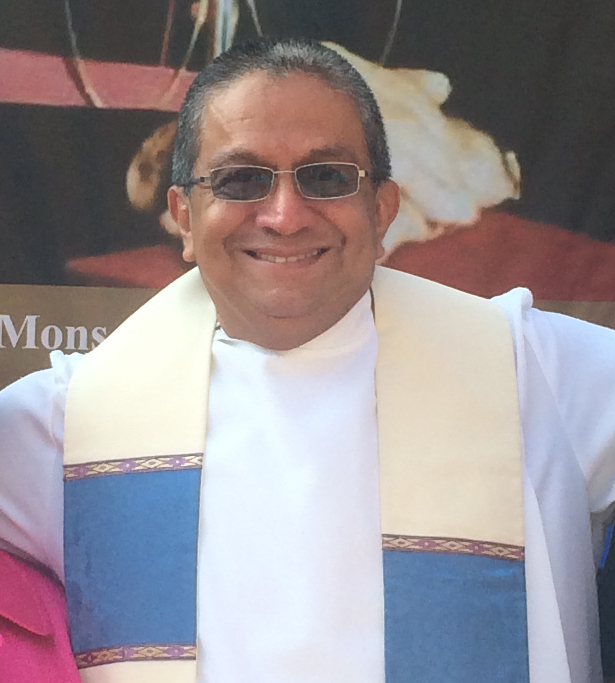 "I am a CISPES supporter because continuing to fight for social justice and a more people-centered country means continuing the dream and sacrifice of thousands of my fellow Salvadorans who died for that vision.” - Padre Carlos, New York City