FMLN Appears Poised for Victory on Eve of March 15 Election
Check out updates throughout election day at
http://cispes.org/09electionsblog
Also in this update:
On Wednesday, March 11 — just four days before El Salvador's historic election for president and vice-president — 5 Republican Congressmen gave speeches on the floor of the House of Representatives threatening that Salvadorans living in the U.S. would lose their immigration status and be outlawed from sending money home to their families if voters in El Salvador elect the opposition FMLN party's candidate on Sunday. "Those monies that are coming from here to there I am confident will be cut, and I hope the people of El Salvador are aware of that because it will have a tremendous impact on individuals and their economy,” stated Rep. Dan Burton (R-IN). Similar threats by U.S. officials were made during the 2004 Salvadoran presidential campaign.
The Republicans’ statements were on the front pages of the widest circulating daily newspapers on the morning of Thursday, March 12, the day after the presidential and vice-presidential campaigns legally closed, leaving the FMLN unable to respond to the threats CISPES, along with many parter organizations around the country, mobilized its activists in the U.S. to demand public statements of neutrality from the State Department in Washington and the U.S. Embassy in San Salvador.
After receiving what it referred to as an “inundation” of
phone calls from citizens around the U.S. on Thursday the 12th, the
State department released a statement of neutrality, saying “The U.S.
government reiterates its official position that it does not support
either candidate in the upcoming presidential election in El Salvador
on March 15th… The separation of powers and freedoms in the United
States allows the debate in which members of the U.S. Legislature have
expressed their opinions, which do not necessarily reflect the official
position of the United States.” Later that day, the U.S. Embassy in El
Salvador also released a statement saying, “The U.S. Government will
respect the will of the Salvadoran people and will seek to work
constructively with whoever wins that election.”
Then the next morning, Friday March 13,
Rep. Howard Berman (D-CA) stated, “As Chairman of the House Committee
on Foreign Affairs, I am confident that neither TPS [temporary
immigration status granted to Salvadorans in the U.S.] nor the right to
receive remittances from family in the United States will be affected
by the outcome of the election, despite what some of my colleagues in
Congress have said.”
At
a press briefing later that day, Thomas Shannon, the State Department’s
top diplomat for Latin America stated, “We are committed to free and
fair elections in El Salvador. And we've also made it very clear that
we will work with whomever the Salvadoran people elect.” All of these
statements of neutrality were subsequently covered in the Salvadoran
media, and come on the heels of a March 5 letter signed by 33 members
of Congress calling for the Obama administration to take just such a
position. That letter was published in its entirety in El Salvador's
highest-circulation newspaper, La Prensa Gráfica, on March 14.
FMLN closes presidential campaign with massive carnival, underscores need to defend against fraud
On
Saturday, March 7, the FMLN (Farabundo Martí National Liberation Front)
held a massive carnival to celebrate the closing of the presidential
campaign and the upcoming election on March 15th. Over
300,000 supporters converged on the Alameda Juan Pablo II in a sea of
red to listen to speakers, enjoy music, and fill the area with chants
vocalizing their support for FMLN presidential candidate Mauricio Funes
and vice-presidential candidate Salvador Sanchez Cerén.
Caravans
of people arrived from all over the country to join in the celebration
that was scheduled to start at 4 PM, though people began arriving hours
earlier. As the sun set, fireworks lit up the sky as the crowd raised
their fists and sang “El Pueblo Unido Jamas Será Vencido” (“The People
United Will Never Be Defeated”). Saturday’s festivities highlight the
popular support for the FMLN presidential “formula,” which is leading
in the polls and continuing to build alliances and receive endorsements
from outside the party.
Sanchez
Cerén addressed the women in the crowd, anticipating Sunday’s
celebration of International Women’s Day and encouraging all women to
be protagonists of change in El Salvador. The carnival concluded with a
speech by Funes, in which the candidate called for a massive turnout on
Election Day and for everyone to take responsibility to defend the
victory. He expressed concern about the potential for fraud on March 15 and urged those present to be vigilant.
The
governing Nationalist Republican Alliance (ARENA) closed its campaign
the next day at the Estadio Cuscatlán, gathering 70,000 people and
encouraging them to protect El Salvador from “the reds.”
In the weeks and months leading-up to the March 15th
presidential election, international observers from the Organization of
American States (OAS) and independent non-governmental organizations
have expressed concern over the potential for irregularities. The OAS
report of January’s municipal and legislative elections stressed the
failure of the Supreme Electoral Tribunal (TSE) to make the Electoral
Registry available in its entirety to all political parties. To date,
the FMLN has not had access to this list of all eligible voters, which
has prevented investigation into numerous reports of irregularities in
the Registry.
Nicaraguans and Hondurans bussed into Antiguo Cuscatlán
On
Monday, March 9, residents of Antiguo Cuscatlán in the department of
San Salvador reported the presence of buses filled with Nicaraguans and
Hondurans who were being given Salvadoran ID cards (DUIs), presumably
to vote in the March 15th presidential election.
International observers affiliated with the Salvadoran Foundation for
Local Development and Democracy (FUNDASPAD) responded to the citizen
denouncement and found two buses parked in front of the City Hall that
were full of people who hid when the observers approached. The
observers noted that the bus passengers spoke with Honduran and
Nicaraguan accents. Nearby business owners reported that there were
many other buses that had come and gone during the day.
The
citizen denouncement reported that the foreigners were being taken to
the fourth floor of the City Hall parking garage and given false DUIs. An
individual wearing an ARENA shirt who spoke on the condition of
anonymity told journalists that buses had been arriving all day from
the East and the passengers were being taken to the parking garage for
a meeting about the March 15th presidential election. The
FUNDASPAD observers saw a line of individuals leaving the City Hall
parking garage and rapidly returning to the buses.
In the days before the January 18th
municipal and legislative elections, Nicaraguan and Honduran
individuals with Salvadoran DUIs were detained in route to Voting
Centers in Morazán, La Unión, and San Miguel. An audit of
the Electoral Registry conducted by the Organization of American States
(OAS) in December of 2007 found numerous irregularities, including the
presence of deceased people and people who had migrated to the United
States. The OAS provided instructions for purging the Electoral Registry that the TSE never completed. This,
along with the reports of foreigners with DUIs, and the fact that a
private company produces DUIs, has raised the concern of many
International Observers about the potential for fraud in the March 15th presidential election.
Salvadorans march against Free Trade Agreement with Europe
One
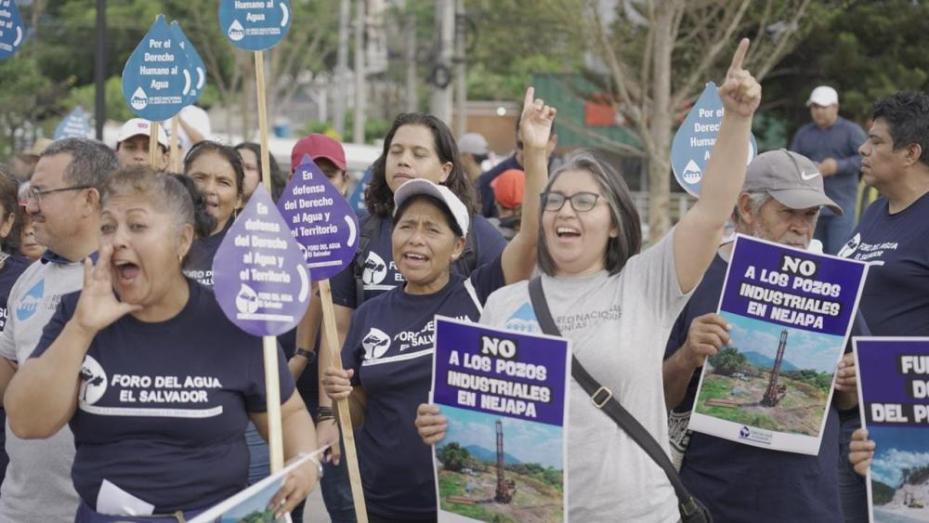
Tuesday, March 10, families participated in a march against the Free
Trade Agreement between Central America and Europe (AdA) that is
currently being negotiated between the European Union and El Salvador. Many of the signs being carried also called for a repeal of the Central American Free Trade Agreement with the US (CAFTA). A statement outlining ten reasons to be opposed to the AdA was circulated. Amongst
the reasons were that the treaty would increase the gap between the
wealthy and poor, privatize public services, and legalize the depletion
of biodiversity and natural resources. The march,
organized by a group called Red Sinte Techan, concluded at the
Legislative Assembly, where a statement outlining the group's position
was delivered.
One
of the participants of the march, an 80-year old man who identified
himself as Germán, said, “The assets [of El Salvador] are for us…we
cannot just endure while they eat well and fill their pockets with
money.” Many of the marchers have never had a suitable home. Mirna Esperanza Herrera, from Santa Ana, told reporters she had always lived along the railroad tracks.
The
AdA is very similar to CAFTA in that it would remove import taxes from
most goods and allow private companies to sue governments for lost
investments. Many economists have faulted CAFTA for El Salvador’s economic crisis and the downfall of its agricultural industry. Economist
Raul Moreno has also pointed out the danger of CAFTA’s provision that
allows companies to sue governments for lost investments. In
2008, a US subsidiary of the Canadian-based Pacific Rim mining company
filed a Notice of Intent (NOI) to sue El Salvador for lost investments
on a mining project in Cabañas. The lawsuit, which could
be filed any day now that the NOI waiting period has expired, would be
the first lawsuit of its type for the country and could potentially
cost the government millions of dollars.
Right wing denounces CISPES
A
March 6 article by the EFE wire service reports that an ARENA party
representative in Miami, Florida, José Alfredo Ávila, criticized CISPES
for its support of U.S. Rep. Raúl Grijalva's March 5 letter in support
of free and fair elections in El Salvador. Thirty-three members of the
United States Congress signed the document that asked President Barack
Obama to publicly state his administration's position of neutrality and
respect for the will of the Salvadoran voters.
Ávila dismissed
the lawmakers' call for U.S. neutrality, saying “they [CISPES] were the
ones who came up with this idea for the letter and asked the Members of
Congress for their support.”
ARENA rejects the premise that
the United States has intervened in past elections, and on these
grounds views the Congressional letter as “an insult.” The ARENA
spokesman said that the relationship between the United States and El
Salvador has “never” produced any intervention in the internal affairs
of either country. However, the Congressional letter was accompanied by
extensive documentation of interventionist statements and threats made
by high-ranking U.S. officials during El Salvador's 2004 presidential
campaign.
In their letter, the Members of Congress stated
their own commitment to “honoring and respecting the will of the
Salvadoran people when they go to the polls on March 15,” and affirmed
that they look forward to working toward a positive relationship with
whichever party is elected on Sunday.
|