In response to these acts of violence, Human Rights
Ombudsman Oscar Luna called for a Non-Violence Accord among all of El
Salvador’s political parties. Initial talks to
sign an agreement to establish that violence will not be used as a campaign
tactic took place among party representatives and Mr. Luna on September
12.
The FMLN had proposed a similar accord among El
Salvador’s political parties earlier in the
summer, though ARENA refused to make such a commitment until after the September
4 attack. FMLN legislative deputy Robert Lorenzana stated, “We want a peaceful
campaign. We regret the incidents of [September 4], and for this reason it is
necessary to coordinate information among the parties to avoid such
incidents.”
Institutional crisis
within National Civilian Police worsens
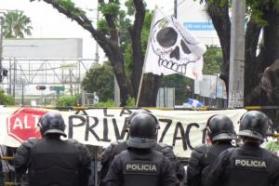
National Civilian Police (PNC) Director Francisco Rovira
resigned from his position on August 19, after only six months as head of the
institution. Rovira’s resignation was officially “voluntary,” however several
PNC officials have publicly stated that Rovira was under pressure to step down
after being accused of hiring advisors with links to gangs, among other internal
issues. President Antonio Saca confirmed Former PNC Assistant Director José Luis
Tobar Prieto to take over the top position in the institution on September
2.
Rovira’s departure is seen by some as sign of the PNC’s
continued decline. According to David Morales, a lawyer for legal well respected
community oriented Foundation for the Study and Application of the Law (FESPAD),
“the regrettable thing about Rovira was his brief tenure, in which he made
demagogic promises for the purpose of projecting a good public
image.”
Human Rights Ombudsman Oscar Luna reiterated prior
reports by his office which show that the PNC is the institution most frequently
accused of human rights violations. It is hoped that the change of directors
will improve the conduct of the PNC. Luna and Morales concurred that the
institution has sharply deteriorated since its creation as part of the 1992
Peace Accords. Recent years have seen a sharp increase in repressive and
politically motivated operations carried out by the PNC. Furthermore, there are
credible reports of death squad-like structures operating within the PNC’s
ranks.
The role of Rodrigo Ávila – the former PNC Director who
resigned in January in order to become the ARENA party’s presidential candidate
– has been called into question by the FMLN. According to FMLN legislator Benito
Lara, a member of the Assembly’s Public Security Commission, “Ávila must answer
for this. Rovira was only there for six months.” Lara added that the
institutional deterioration of the PNC has been detected since shortly after the
Peace Accords brought it into existence
FMLN holds convention,
candidates officially register for ballot
The FMLN held its 24th General Convention on August 17,
during which the party presented its Plan of Government for 2009-2014. This
document was produced through the party’s Open Social Dialogue, an extensive
process of consultation with citizens throughout El
Salvador.
The plan, unanimously adopted by the delegates, lays out
a strategy for achieving the true realization of the 1992 Peace Accords, which
ended 12 years of civil war. The ARENA party, in power since 1989, has been
accused of ignoring and neglecting numerous provisions of the Accords.
Additionally, the FMLN’s program emphasizes health care, education, and the
strengthening of the national economy.
In other electoral news, FMLN candidate Mauricio Funes
took part in an event to officially join the party on August 27. The ceremony
was attended by a large crowd representing various social sectors, as well as
party officials and activists. Shortly thereafter, Funes and his running mate,
Salvador Sanchez Cerén, officially registered as candidates with the Supreme
Electoral Tribunal.
On the other hand, ARENA has yet to select it’s vice
presidential candidate or present its plan of government. Instead, the right
wing party seems to have devoted its energies to attempting to delegitimize the
FMLN, largely through attacks in the media against policies such as Alba
Petróleo, an international program that brings cheap oil imports from
Venezuela.