|
After the government’s
February 8 admission that it did not have evidence to substantiate the original
terrorism accusations, the charges were reduced to “public disorder” and
“aggravated damages,” crimes carrying sentences of up to 4 years. Accordingly,
the case was moved from the jurisdiction of a special anti-terrorism tribunal in
San Salvador –
also established by the 2006 law – to the regular court system in Suchitoto.
On Tuesday, the judge in
Suchitoto dismissed the new, lesser charges, granting the defendants “definitive
liberty” after the prosecution failed to appear at a preliminary hearing to
present evidence. The government’s attorneys later said their car broke down en
route to the court. It is unclear whether the government will seek to appeal the
decision.
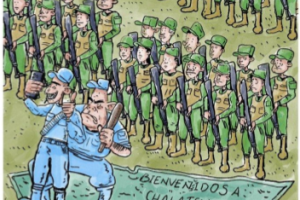
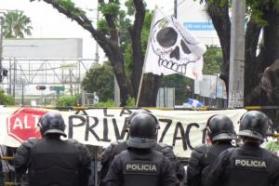
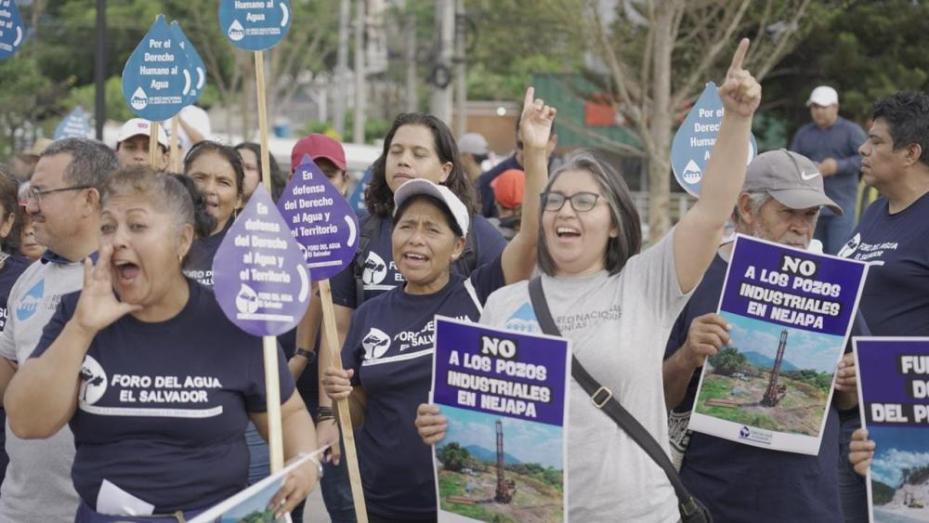
The “Suchitoto 13” were
violently arrested at a July 2, 2007, demonstration against Salvadoran president
Antonion Saca’s plan to “decentralize” Suchitoto’s public water system, a move
that was widely viewed as a first step toward the eventual privatization of that
system. Following their arrests, several of the defendants were psychologically
tortured by members of El
Salvador’s National Civilian Police (PNC), a police force
that the U.S. State Department has praised as one of the best in Latin America,
and which it trains at the International Law Enforcement Academy (ILEA) in
San
Salvador.
Starting on Monday,
February 11, various social organizations participated in a three-day march from
Suchitoto to San
Salvador to ensure that public attention remained focused
on the case, even after the charges had been reduced. The march had two clear
messages: opposition to El
Salvador’s anti-terrorism law and the call for
all charges to be dropped in the Suchitoto case. The latter demand was met with
Tuesday’s court ruling. In support of the march, the mayor of Soyapango, Carlos
Ruiz of the FMLN party, declared, “this is a protest to say ‘No more state
terrorism!’ It is a just, rebellious response to
oppression.”
In a further
development, the Supreme Court of Justice petitioned the Legislative Assembly to
rule on the constitutionality of the Special Law Against Acts of Terrorism,
approved by a right-wing block in September 2006.
ARENA’s smear campaign
against FMLN bolstered by U.S. intelligence report; FMLN
proposes campaign finance reform
In a recent visit to the
United States, Salvadoran
president Antonio Saca expressed concern about the findings of a recent
U.S. intelligence report,
which predicts that Venezuela
will intervene in El
Salvador’s 2009 elections. In his Annual Threat
Assessment, U.S. Director of National Intelligence Mike McConnell states that
“we expect [Venezuelan president Hugo] Chávez to provide generous campaign
funding to the Farabundo Martí National Liberation Front (FMLN) in El
Salvador in its bid to secure the presidency in
the 2009 election.”
Similar U.S. national
security reports, later exposed as false and comprised of
politically-manipulated intelligence, were used by the Bush administration to
justify its preemptive war against Iraq in 2003. Nevertheless, Saca ordered an
investigation into the U.S.’s
claims and recalled a diplomat from Venezuela for consultations, declaring, “we are
instructing the diplomat to return to El Salvador to provide first hand
information on this topic.”
Additionally, Saca
warned that “any interference of a government such as Venezuela’s in El
Salvador’s domestic affairs is unacceptable.”
Conversely, Saca seems to view electoral intervention by the United
States government as not only acceptable, but
welcomed. In a November 2007 press conference with President Bush, Saca stated
that the U.S. “can help out a lot in
preventing citizen support for certain proposals in the upcoming
elections.”
FMLN presidential
candidate Mauricio Funes denied the U.S.’s accusations and pledged that his party
would not receive financing from Venezuela. Funes promptly proceeded
to propose a campaign finance reform package to the Legislative Assembly that
would cap campaign spending, mandate transparency in campaign financing and
expenditures, and ban donations from foreign
sources.
For his part, Venezuelan
president Chávez also dismissed the intelligence report, stating that the FMLN
did not need his support because it is a “solid” and “well-organized” party with
popular support. “It’s a lie. We don’t need to do that, and they don’t need it,”
Chávez said.
In further response to
the U.S.’s claims, Saca’s right-wing ARENA party accused the FMLN not only of
accepting electoral financing from Venezuela, but also of allowing economic
intervention by means of a petroleum importation agreement between FMLN
municipalities and the Venezuelan state oil company. ENEPASA, the enterprise
that imports and distributes subsidized oil from Venezuela, publicly expressed its
willingness to submit to any type of investigation and insisted that it has
complied with all legal requirements and paid all necessary taxes for the
project.
Assassinations of mayor
and municipal employee in Alegría remain
unsolved
Hundreds of family
members and social organization representatives took part in a public
demonstration in the central park of the municipality of Alergría on Sunday, February 17, to call
for justice to be served in the double assassination that occurred in the town
last month. On January 9, the young mayor of Alegría, Wilber Funes, was shot
dead along with municipal employee Zulma Rivera as the two drove to an outlying
area of the municipality to assess progress on a public works project. Sunday’s
activity was supported by Funes’ FMLN party, which gathered signatures on a
petition to Attorney General Félix Safie demanding that this case not result in
impunity.
More than a month after
the killings, there has been little sign of an investigation moving forward.
Although the Attorney General’s office says it has identified suspects, no
arrests have been made. During Sunday’s event, the father of Zulma Rivera
offered his analysis of the situation, stating, “if justice is not carried out,
it is because they don’t want it. The killers are from here, from Alegría.” He
added that he believes there are people in the municipality who are concealing
the identities of the assassins.
|