|
link to this article at the San Francisco Bay View
by J.L. Heyward, Bay Area CISPES
|
"We're under domestic
insurgency. If we don't get it, it will get us." - California Attorney
General Jerry Brown, Anti-Gang Conference, Riverside, Calif., December
2007
"We're mounting a coordinated, aggressive suppression strategy that
targets the worst offenders and the most violent gangs. We're
converging local, state, federal and even international efforts ...
coming at them with everything we have." - Los Angeles Mayor Antonio
Villaraigosa, Feb. 8, 2007, press conference
On May 1, 2007, Los Angeles Police Chief William Bratton was
scheduled to visit El Salvador with Mayor Antonio Villaraigosa to
announce a new policing partnership between Los Angeles, Mexico and El
Salvador.
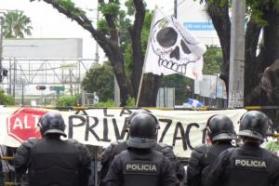
His plans were interrupted, however, by a brutal LAPD attack on a
peaceful immigrant rights rally in MacArthur Park. Riot police stormed
the park, assaulting the crowd with teargas, clubs and rubber bullets,
then trampling and beating two mainstream journalists and chasing
people into the streets.
|
Villaraigosa made the visit to El Salvador alone. Insisting that he
wouldn't let "the immigration issue" distract from the purpose of his
trip, the mayor tried to distance himself from police violence at home
while depicting El Salvador as a new frontier in trade and tourism but
lacking in security. What he did not disclose, of course, was the fact
that the Salvadoran National Police (PNC) has been at the forefront of
El Salvador's safety concerns, having been recently implicated in eight
political assassinations, an attack on a student march at the National
University, at least a dozen violent raids on street vendors and two
student disappearances since the opening of a new U.S. police training
academy in El Salvador - the International Law Enforcement Academy
(ILEA).
Instead, he attributed El Salvador's instability to "gangs" and
signed an additional contract with the director of the PNC, Rodrigo
Avila, "to track and detain cross-border gang members and Salvadoran
deportees." Under the agreement, officers from the Los Angeles Police
Department's gang unit share training, tactics and intelligence with
the Salvadoran force. The program is intended to augment Salvadoran
President Tony Saca's "Mano Dura" (Iron Fist) policy, a severe version
of former New York Mayor Rudy Guiliani's Zero Tolerance Program.
"These laws are never intended to solve crime," says FMLN deputy
Lorena Peña, "but to criminalize the poor. Now there's the
anti-terrorist law and the people of the informal sector, unions and
organizers have come under increased repression - all under the guise
of stopping crime. The right has a policy of keeping people terrorized
by selectively murdering organizers and people on the left to strike
fear."
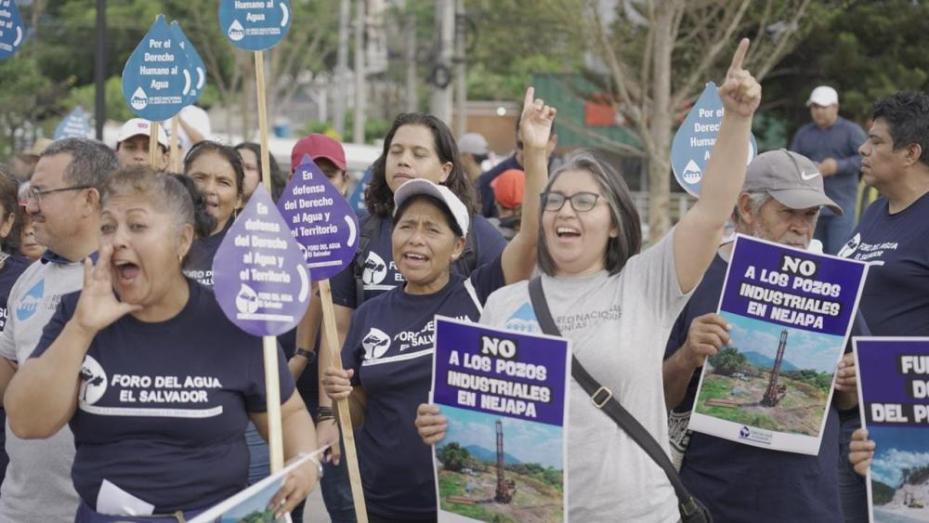
In the seven months that followed Villaraigosa's visit, the PNC
carried out another massive raid on street vendors in San Salvador that
resulted in the brutal arrests of 28 street vendors, an attack on a
water privatization protest in Suchitoto where 14 people were arrested
and an invasion of a rural community, Cutumay Camones, in Santa Ana on
behalf of a private sewage company that resulted in a four-month-long
standoff.
The 28 street vendors and 14 Suchitoto protestors were charged with
"acts of terrorism" under the Salvadoran right wing's new
anti-terrorism law. The Law against Acts of Terrorism criminalizes the
"simulation, preparation, financing and organizing of any mobilizations
and other acts of protest." While the charges on the vendors were
eventually dropped, the Suchitoto charges still stand and, if found
guilty, protestors could spend up to 60 years in prison for organizing
a street march.
The PNC's actions and the Salvadoran government's interpretation of
terrorism have been consistently endorsed by the U.S. State Department.
Before he was forced to resign, U.S. Attorney General Alberto Gonzales
initiated the first phases of the U.S.-Salvadoran "anti-gang" agreement
and suggested that the Salvadoran government consider also implementing
the death penalty.
Upon leaving his post as U.S. ambassador in 2007, Douglas Barclay
applauded the ARENA government's achievement of approving the
Anti-Terrorism Law and urged officials to apply it and create more
repressive laws - including authorization for domestic surveillance of
phone calls - under the pretense of fighting crime.
"First they opened an FBI office and there's an INTERPOL office here
as well," said a member of Movimiento Para Autodeterminaccion, a
Salvadoran human rights monitoring group, in March 2006. "Now they've
opened this police training academy. It's beginning to look a little
bit like the X-Files in El Salvador."
The U.S. State Department has been steadily rebuilding its presence
in El Salvador since 2002. That year, the Bush administration supported
an attempted coup of Venezuelan President Hugo Chavez that failed.
Since that time, Latin America has elected its first indigenous leader,
Evo Morales, in Bolivia, a socialist economist in Ecuador, Rafael
Correa, and two center-left presidents in Central America, in complete
defiance of the Washington Consensus.
The uprising in Oaxaca, Mexico, before, during and after the heavily
contested presidential victory of Felipe Calderon is perhaps one of the
best illustrations of changing power dynamics and national uprisings
throughout the region and clear evidence that the U.S. is quickly
losing influence.
After a complete round of regional elections, Latin America has left
Washington with only lukewarm support of the U.S.'s "trade expansion"
plans - or neocolonial project - and almost nowhere to settle down
militarily except in Colombia, where corporate-financed right-wing
militias and left-wing guerilla forces are entrenched in a civil war
almost two centuries old, and in El Salvador, where the right-wing
ARENA party - founded by former death squad architect Roberto
D'Abuisson - has exercised social control through brutal economic,
electoral and military repression tactics that Washington is eager to
reward, refine and replicate.
The FBI opened an office in El Salvador in January of 2005, several
months before the Bush administration engineered the narrow passage of
CAFTA (Central American Free Trade Agreement) through the U.S.
Congress. Recognizing massive opposition on the ground to CAFTA,
Condoleezza Rice announced the opening of the U.S.-sponsored ILEA
(International Law Enforcement Academy) in El Salvador to "enhance the
functioning of free trade ... and to make Latin America safe for
foreign investment."
Fifteen Latin American countries have sent police recruits to the
ILEA to be trained by U.S. Department of Homeland Security in social
control and political repression. Not surprisingly, many Latin
Americans call the ILEA the "School of the Americas for the police,"
intended to train thousands of police recruits in torture and
repression tactics traditionally carried out by the military.
"They're trying to proscribe fear of protest into the public's
imagination." observed Lorena Peña, historic leader of the FMLN, El
Salvador
Less than one week after the first batch of ILEA recruits were
graduated in 2006, Radio Venceremos founder Mariposa Manzanares'
parents were assassinated on July 1, touching off a surge of political
assassinations that continued through the winter. Four days after the
Manzanares executions, an elite unit of the PNC called the UMO ambushed
a student march against bus fare and cost of living increases and the
Salvadoran military attacked, invaded and occupied the National
University in what the Human Rights Office declared "the worst case of
military violence in El Salvador since the signing of the Peace
Accords" in 1992.
The constant and growing response from the Salvadoran social
movement has been mass mobilization against every front of the
government's attacks. The FMLN, former guerilla force turned political
party that governs over 40 percent of the country's population, has
been consistently winning higher percentages of the popular vote as
each election year passes.
While the Latin American left is convinced that this coyuntura, or
blend of political forces in the region, paints the picture of a
falling empire and the "beginning of the end of 500 years of
colonialism," Washington's right wing allies are pulling out every
weapon in the cache. There is no mistaking the parallel between the
U.S.'s mounting presence in El Salvador and the resurgence of death
squad assassinations in El Salvador, just as there is only a thin veil
between "war on gangs" rhetoric and the recent attempts of the federal
government to intervene in local law enforcement on cases relating to
the U.S.'s punishing immigration policy.
Terrorism trials for the Suchitoto 13 will begin on Feb. 8, 2008. Stand in solidarity and defend the right to organize!
|