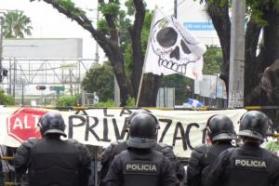
VANCOUVER - Pacific Rim Mining held its annual general meeting in
downtown Vancouver today - attended by a few directors and more than a
dozen protesters.
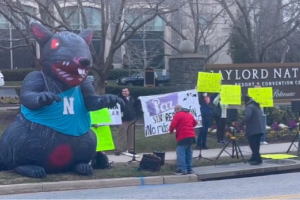
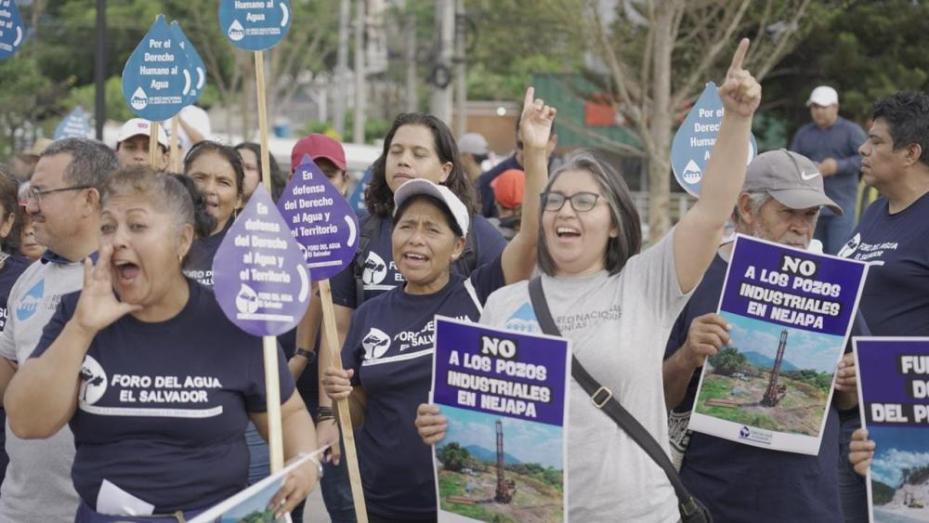
Most of the demonstrators were from the Committee in Solidarity with
the People of El Salvador (CISPES) in the US Pacific Northwest. They
wore tags describing themselves as shareholders in democracy, human
rights, access to clean water and "our future."
Vancouver-based Pacific Rim Mining is suing the people of El
Salvador after the government refused to allow it to mine using methods
that would poison El Salvador's rivers. The suit for millions in "lost
profits" has been filed under the Central American Free Trade
Agreement. CISPES is calling on the company's directors to drop the
suit.
Two CISPES representatives were allowed into the meeting, then ejected after they tried to speak.
World Bank tribunal gives green light to Canadian mining company’s lawsuit against government of El Salvador
WASHINGTON, D.C. – A World Bank tribunal’s decision on Monday to move
forward with a Canadian gold mining company’s controversial lawsuit
against the government of El Salvador highlights a central failure of
U.S. trade pacts to respect the national sovereignty of member
countries.
In 2009, Pacific Rim Mining filed the lawsuit under the rules of the
U.S.-Central America Free Trade Agreement (CAFTA), demanding “hundreds
of millions” of dollars from the Salvadoran government, which rejected
the Vancouver, B.C.-based company application for exploitation permits.
El Salvador’s Ministry of the Environment and Natural Resources argues
that Pacific Rim never completed the necessary process to obtain an
exploitation permit, and local communities have demonstrated widespread
opposition to the proposed El Dorado gold mine based on the
environmental and public health risks of cyanide-leach mining.
In 2005, then-Senator Barack Obama published an opinion piece in the Chicago Tribune
entitled “Why I oppose CAFTA.” In his article, released on the same
date as the Senate vote on the Dominican Republic-Central American Free
Trade Agreement (“DR-CAFTA”), Obama explained that he would not vote
for the bill and voiced his opinion that DR-CAFTA “…does little to
address enforcement of basic environmental standards in the Central
American countries and the Dominican Republic.”1
Despite well-founded fears about the consequences of DR-CAFTA among its
critics, President George W. Bush and his administration lobbied
heavily for the passage of the bill, which was signed into law on
August 2, 2005. El Salvador became the first of the Central American
nations to implement DR-CAFTA after the treaty took effect in the
country on March 1, 2006.
June 18: Anniversary of the death of Marcelo Rivera
Friday, 18 June 2010
Today, June 18th, we solemnly commemorate the one-year anniversary of the disappearance of Marcelo Rivera, community leader, FMLN activist and environmental defender from San Isidro, Cabañas. Marcelo and his brother Miguel co-founded the Asociación de Amigos San Isidro, Cabañas. After one year, the Attorney General has not tried anyone for the murder of Marcelo Rivera, despite international pressure from Salvadorans and allies throughout the U.S. and Canada. Speaking at a rally in Washington, DC in May 2010, Miguel Rivera explained that his brother inspired many others to join him “in the trenches” of the struggle for life, dignity and sovereignty and that Marcelo’s spirit lives on in all those who continue to join this struggle. Next week, members of the CISPES Radical Roots delegation will have the privilege of participating in an ecumenical, cultural and political activity with the local grassroots groups in San Isidro. At CISPES, we honor the life and commitment of Marcelo Rivera by demanding an end to the impunity of his and other political assassinations in El Salvador and by standing in solidarity with the people and communities of El Salvador in calling for a national ban on metallic mining and for the self-determination of the Salvadoran people. ¡Marcelo Rivera, presente!
Videos, photos & articles from rallies around US on Day of Action against Mining and Free Trade
Thursday, 03 June 2010
Last Thursday, May 27 CISPES members and social justice activists
across the country took a stand against corporate greed and the US free
trade model, organizing a number of creative actions for the
International Day against Mining and Free in El Salvador to condemn
Pacific Rim Mining Corp. and its multimillion dollar lawsuit against
the Salvadoran state.
Boston, MA
A diverse crowd of solidarity activists, community high school
youth, faith leaders, unionists, FMLN members and local politicians
rallied in front of the Canadian Consulate, demanding Canadian
government action against Pacific Rim and to stop negotiating the
Canadian Free Trade Agreement with Central America. Massachusetts
State Representative Alice Wolf spoke with the Canadian Consul as part
of a delegation and rallied the crowd in support for the Salvadoran
resistance movement.
New York, NY
President
and CEO Thomas Shrake showed up in downtown Manhattan, peddling Pacific
Rim cyanide water from Cabañas. Intrepid passersby who taste-tested
the new product met with an unfortunate fate.
Watch a video of Pacific Rim's new product and its startling effects here
Press Release: Landmark hearing begins at World Bank arbitration center
Tuesday, 01 June 2010
June 1, 2010
Contact: Alexis Stoumbelis, (202) 521-2510 ext. 205
Landmark hearing begins at World Bank arbitration center;
Environmental scientists and trade policy specialists refute Vancouver-based Pacific Rim Mining’s claims in $77 million lawsuit against El Salvador
As the second day of proceedings by Pacific Rim Mining against the government of El Salvador opens at the International Centre for the Settlement of Investment Disputes (ICSID), the Vancouver-based company continues to assert its unjustified claim for at least $77 million dollars in alleged lost profits after El Salvador denied its application for mining permits.
Vidalina Morales de Gámez, a member of the National Roundtable against Metallic Mining in El Salvador declared, “The company claims that its rights were violated under CAFTA [the US-Central American Free Trade Agreement], but the company failed to fulfill its obligations under Salvadoran law.” Ms. Morales de Gámez traveled to Washington, DC last week for a series of Congressional briefings organized by Public Citizen’s Global Trade Watch and Friends of the Earth concerning CAFTA’s highly-disputed investor rights provisions. “Now Pacific Rim wants a multimillion dollar handout from El Salvador, which is money we need to pay for social programs and to create long-term jobs for the poor and working class.”
Lisa Fuller, Program Director of the Committee in Solidarity with the
People of El Salvador (CISPES), which organized a series of
demonstrations in cities across the US to protest Pacific Rim's
lawsuit, rejects the company's continued assertion of economic benefit
for El Salvador. “The mine, which would operate for just 6 years and
employ several hundred people, would bring very minimal economic
benefit to El Salvador.”
Today began the preliminary hearings against the Salvadoran state, being sued by the Canadian company Pacific Rim, which has accused the government of violating “its rights” for denying mining exploitation licenses in Cabanas.
The trial is taking place in the Center for International Settlement of Investment Disputes (ICSID), a corporate tribunal of the World Bank based in Washington, DC, where Pacific Rim demands that the Salvadoran government give an indemnity of $100 million dollars for hindering the company from extracting gold and silver from national subsoil.
At this time, El Salvador's lawyers have presented their initial objections after which Pacific Rim presented their arguments, based in the provisions of the US-Central American Free Trade Agreement and its investment law.