US Ambassador ransoms aid for passage of Public-Private Partnerships Law
As the keynote speaker at an October 29 breakfast with the Salvadoran Construction Chamber, US Ambassador Mari Carmen Aponte claimed that any renewal of the Millennium Challenge Fund (FOMILENIO), a US development aid program, would be dependent upon the Salvadoran Legislative Assembly’s approval of a proposed Public-Private Partnership (PPP) Law.
FOMILENIO is a foreign aid initiative of the US Millennium Challenge Corporation (MCC), which was created by Congress in 2004, and is funded by US tax dollars. MCC development projects are awarded to countries based on their performance in categories like “Economic Freedom,” “Investing in People” and “Ruling Justly.” The first FOMILENIO project constructed a megahighway in the north of the country. The proposed second FOMILENIO project, still awaiting approval by the MCC Board, would invest in infrastructure along El Salvador's Pacific coast, the site of the country’s main airport and two primary ports.
“It is critical to the vision of FOMILENIO II to have the possibility of public-private partnerships,” said Ambassador Aponte on October 29th. Public-private partnerships, she declared, are a “prerequisite for a second compact with the Millennium Challenge Corporation.” The Ambassador’s assertions were trumpeted in articles in the nation’s two largest newspapers, the Prensa Gráfica and the Diario de Hoy, as well as on the US Embassy’s webpage. At the breakfast with the country’s largest construction companies, Aponte vowed that any second FOMILENIO agreement would include $50 million exclusively for private companies working through public-private partnerships.
The PPP Law is an initiative of the Partnership for Growth, a bilateral US-El Salvador development framework agreement that seeks to promote and incentivize foreign investment in El Salvador. The proposed law creates a mechanism to auction off public services and infrastructure to private corporations for management and partial ownership, from airports and highways to universities and municipal services. The PPP Law would therefore be enormously beneficial to US and transnational companies hoping to profit off of the proposed FOMILENIO II coastal infrastructure projects.
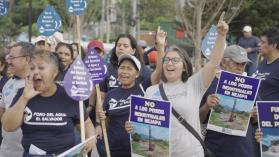
But Salvadoran social and labor movement leaders see the initiative as an effort to disguise deeply unpopular privatizations as ‘development.’ Salvadoran economist Raul Moreno describes the law as a “modality of associating pubic companies with private capital, principally foreign investments, as a new way to push this neoliberal model that in El Salvador and throughout the world has demonstrated its demise.” He considers the PPP Law a mechanism to bring profits to foreign, and principally US corporations, diverting revenue from the state into private hands at the expense of public services and public sector workers.
Ambassador Aponte protests that “public-private partnerships do not imply privatizations,” but the Salvadoran labor and social movements disagree. Jose Alberto Cartagena Tobias, a leader in the Airport Workers Union (SITEAIES), fears that the law’s passage would bring union-busting, wage cuts and flexibilization to public sector jobs. “For us,” he says, “Public-private partnerships are nothing more than privatization.”
Funds for infrastructure like the proposed $300 million in the FOMILENIO II project are scarce in El Salvador, where the tax system already provides generous breaks for private, and especially foreign, businesses. This is not the first time that US officials have leveraged these much needed funds for their political and economic interests. In July this year, US senators threatened FOMILENIO II funds in order to influence an internal political conflict playing out in El Salvador at the time. And the Partnership for Growth agreement has also been used by the US before in order to pressure for leadership changes in El Salvador’s Ministry of Security.
Ambassador Aponte’s latest statements undermine the Salvadoran Legislative Assembly’s sovereign duty to respond to their constituents’ interests when approving legislation. The US government is effectively holding the FOMILENIO II funds ransom for the approval of a law that would allow for the investment of those funds on the US’s terms – terms that would make the global 1% wealthier at the expense of Salvadoran working families.

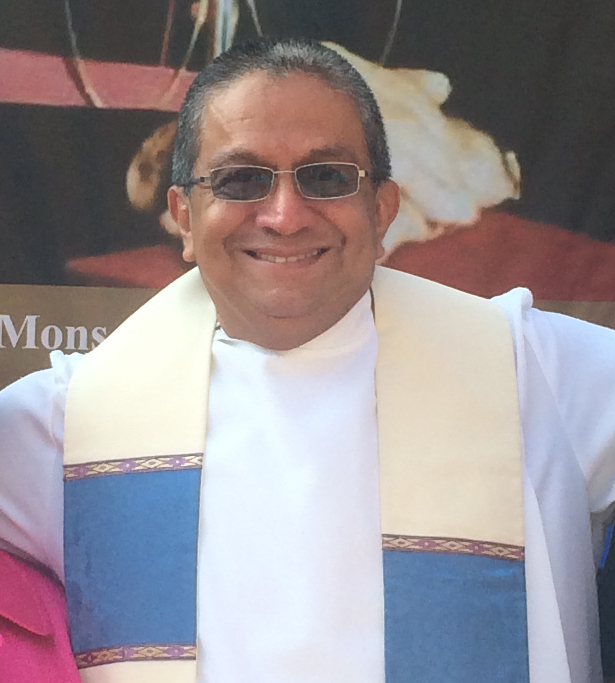 "I am a CISPES supporter because continuing to fight for social justice and a more people-centered country means continuing the dream and sacrifice of thousands of my fellow Salvadorans who died for that vision.” - Padre Carlos, New York City