FMLN Swept from Public Security Cabinet, Replaced by Officials and Military Officers Close to the US
Click here to take action against the re-militarization of El Salvador! On Monday January 23, the Funes administration named retired general Francisco Ramón Salinas as the new director of El Salvador's National Civil Police (PNC), replacing former Director Carlos Ascencio and thus removing the last high-ranking member of the public security cabinet linked to the leftist Farabundo Martí National Liberation Front (FMLN). Prior to his naming, Salinas was Vice-minister of Defense and an active duty general; he officially retired from military service several hours before Funes appointed him. This cabinet change has been extremely controversial. The PNC is a civilian institution that was created by the 1992 Peace Accord negotiations that ended the Salvadoran Civil War with the intention of removing the Armed Forces from any role in public security, specifically because of the long history of human rights violations by the military. FMLN Secretary General Medardo González has called Salinas' appointment unconstitutional and a violation of the Peace Accords. Funes claims this is not true; however, Article 168.17 of El Salvador's Constitution states that the President is responsible for, “Organizing, leading, and maintaining the National Civilian Police for the protection of peace, calm, order, and public security both in urban zones as well as rural zones with a strict respect for human rights and under the direction of civilian authorities.” (Emphasis added by author) Upon hearing of Salinas' appointment to head of the PNC, the PNC Inspector General Zaira Navas promptly resigned. Navas has aggressively investigated and purged hundreds of corrupt police officers of all ranks, earning praise from many - including Congressman Jim McGovern (D-MA) - and death threats from others. Salinas' appointment is the latest in a series of changes announced by Funes that has swept every single FMLN member out of the security cabinet, and placed military officers in the highest-ranking public security posts. These changes began last November when Public Security Minister Manuel Melgar, a member of the FMLN appointed by Funes in 2009, was replaced by then Minister of Defense Mungía Payés, another recently retired general. The US State Department had been pushing Funes to remove Melgar since 2009, while at the same time using economic and security cooperation initiatives like the Partnership for Growth and the Central American Regional Security Initiative to pressure El Salvador to use more militaristic approaches in its fight against narcotrafficking and gangs. The new Public Security Minister's agenda bears uncanny resemblance to the militarized "War on Drugs" policies promoted by Washington in Latin America, like Plan Colombia and Plan Mexico (Mérida Initiative). Minister Munguía Payés has declared a “War on Gangs,” fought with aggressive strategies to regain control of “gang territories” throughout the country. As part of the new “war,” Munguía Payés has created specialized anti-gang police units that are being trained by the Salvadoran military and US security personnel. He has also proposed a new “subsystem” of justice with special prosecutors and judges that only deal with accused gang members. Payés' “War on Gangs” - which amounts to a war on the young and impoverished who have been forced into gangs by the lack of economic opportunity - is a far cry from ex-Minister Melgar’s focus on fighting the shadowy network of powerful organized crime figures, many with documented connections to El Salvador’s oligarchy and political elite. When Melgar was replaced by Munguía Payes in November, FMLN Spokesperson Roberto Lorenzana predicted that additional high-ranking FMLN security officials would also be replaced, furthering the shift in public security from civilian to military control. Lorenzana named both PNC Director Ascencio and Roberto Linares, Director of the State Intelligence Organization, (OIE in Spanish, El Salvador’s FBI) as likely candidates for removal. Today, about 2 months later, Lorenzana's predictions have come true and both of these FMLN functionaries have been replaced. Prior to Ascencio's dismissal this week, the Funes Administration announced the removal and replacement of Roberto Linares a few weeks ago. The new director of OIE is Ricardo Perdomo, who served as Minister of Economy under the Duarte administration (1984-1989) - a right-wing administration that dramatically escalated the Civil War and worked very closely with the US government. Since Perdomo has no professional experience in the area of intelligence, many expect that active duty Colonel Simón Molina Montoya, who is the newly-appointed 2nd in command of OIE, will be calling the shots - especially since Colonel Molina was Munguía Payes' intelligence advisor when he was Minister of Defense. Funes' rapid security cabinet changes have delivered control of El Salvador's security policy to military logic and personnel in just about 2 months' time. These changes - which began with US pressure against Manuel Melgar - taken along with the naming of functionaries close to the United States, have consolidated US influence in the security cabinet precisely at a time that the US is attempting to seal up a geopolitical security corridor from Mexico to Colombia, ostensibly to fight the “War on Drugs.” The changes are an unfortunate and alarming step backwards on the 20th anniversary of the Peace Accords, celebrated just over a week ago, which strictly removed military participation in domestic security after the brutal state-linked repression that left 75,000 dead during the Civil War.
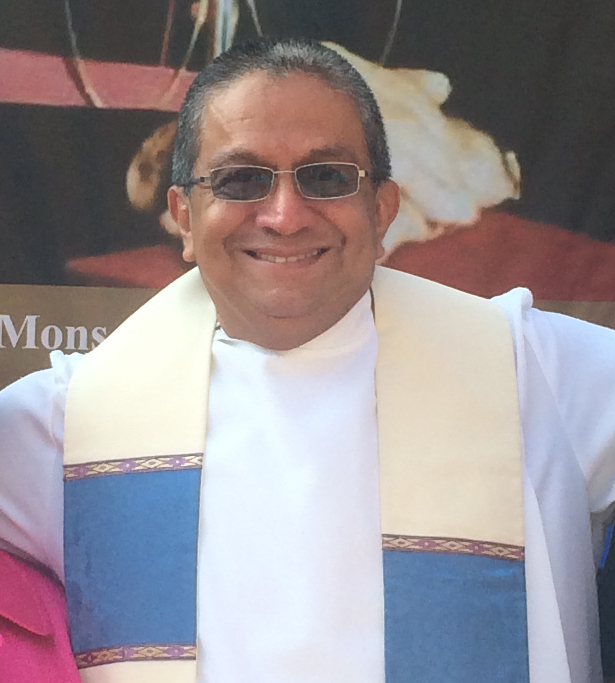 "I am a CISPES supporter because continuing to fight for social justice and a more people-centered country means continuing the dream and sacrifice of thousands of my fellow Salvadorans who died for that vision.” - Padre Carlos, New York City